
Prof Nathu R Puri CBE
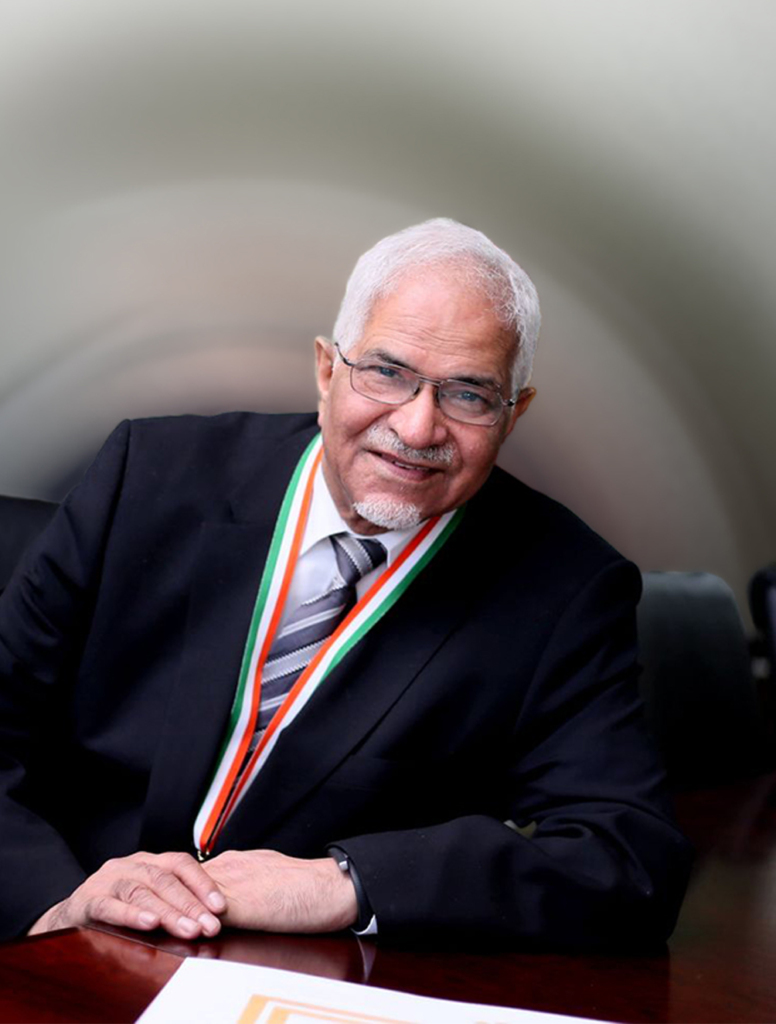
Founding Chairman
Purico Group Ltd | Nottingham (UK)
Ancestry & Birthplace:
Mullanpur Garib Dass (now New Chandigarh), Punjab (India)
Residence:
Nottingham (UK)
A JOURNEY FROM HUMBLE BEGINNINGS
Named after its inspirational founder Prof Nathu ‘Nat’ Puri CBE, the Purico Group transformed itself from a one-man consultancy into a global business empire spanning multiple continents. This is his journey of inspiration.
Nat arrived in England in 1966 to train as an engineer prior to his planned entry into Indian politics, having been surviving as a truck driver back in India. However, as circumstances conspired, he still remains in the UK.
In the UK, his greatest disadvantage as an engineer soon became his greatest advantage. Having no preconceived ideas was a big boon when trying to find solutions to difficult problems. He simply did not know something could not be done. This pushed him in August 1975 to set up his own engineering consultancy and he achieved a great deal of success as a consultant, working on many buildings, hospitals and RAF stations. His experience broached into Architecture, Quantity Surveying, Structural Engineering and of course, Building Services, which was his primary expertise.
In 1983, he set up Melton Medes Ltd, or as it is known today, Purico Ltd. The Purico Group is a medium-sized family enterprise based out of the UK with businesses across the world – it’s pioneering vision is to provide the highest quality of work and satisfaction to its customers, often through harnessing the latest in technology and business practice. Purico aims to pursue excellence in everything it does. It fills Nat with a special kind of pride when discussing how far his business has come, especially considering its difficult beginnings, with the business now spanning sectors as diverse as: Automotive, Care, Construction, Hospitality, Paper and Property. But Nat takes the most pride in how he has used the wealth he has generated to support those in a less fortunate position than himself. The journey however has not been without its fair share of pitfalls, roadblocks, detours and blind corners. That is life, after all, and, as he says, it’s all in the game.
Early life in Punjab
Born in 1939 to Munna Lal and Godavari Puri, Nat spent his childhood growing up in the beautiful landscape of Punjab. His Father and Uncle ran a small money lending business in the village. Local traders would leave deposits with them, which they would then lend to local farmers, with interest applied. Nat’s Father had in fact been a Maths teacher prior to his birth, and the words his Father used to say always stuck with him: “It does not matter if you can read or write, so long as you can count!” Those stark words certainly had an impact on young Nat and he always worked hard on his Maths, something which he still espouses to all those close to him. His Mother was devoutly religious and always worked hard at home to raise him and his siblings – a work ethic he never forgot either.
As a child born under British Rule, Nat always wanted to join the freedom movement when he grew up. He loved listening to tales about the heroism of Bhagat Singh, Rani Jhansi and others. In 1947, India gained its Independence, however, the Partition came at a great cost, with much bloodshed, violence and hardship. His family lost everything as the money-lending business collapsed and there was great communal strife in the area – an experience that greatly shaped the young boy and something from which his Father never fully recovered from.
Nevertheless, his schooling continued. All the students helped build the school he attended. Even at such a young age, the students were often handling brick and mortar and it was an experience that reminded him of the value of education (although he admits that he wasn’t always the best student, often playing truant to go and hang out with his friends).
In 1953, Nat left to join Government High School in Chandigarh, later joining the Government College, Chandigarh in 1955. For higher education, he attended SA Jain College, Ambala, to study for his BA in Pure and Applied Maths. Whilst there, he organised and lead a student strike over what he describes as the wrongful and targeted arrest and expulsion of some of the poorer students. The experience compelled him to leave and join SD College Ambala Cantonment (now part of Panjab University) where he finally attained his degree. One of his university classmates was future Justice Manmohan Singh Liberhan (who notably chaired the Liberhan Commission) and is a friend to this day. Nat then decided to take up postgraduate studies in Psychology because the department had a lot more girls in it, though was unable to fund his studies beyond just a few months of the course. However, it all turned out to be one of the best decisions he ever made for his future career – he greatly utilised the knowledge and critical skills he had learnt there throughout his life – even though the importance of his decision was not apparent at the time and perhaps, not made for the wisest of reasons he says.
The journey begins
Nat’s Father had a one-third share in a truck and life after his university education was generally as a truck driver. However, after a serious road traffic accident in which he nearly lost his life, he ended up working as a coal merchant in Chandigarh. Throughout this period of his life, he became friends with Shri Morarji Desai and contacted him regularly – he still greatly admires the man who would later become Prime Minister of India (he was then the Chairman of Administrative Reform Commission). However, politics didn’t inspire Nat enough to give up what he was already doing, not without professional qualifications to fall back on at least – he says he had no intention of becoming just another corrupt politician who relied on kickbacks to make do. That’s when he applied to pursue technical studies in London, as he knew training in engineering would give him a good trade to support himself and help fund him through any political career. He relied on his older brother Kali, then a mining engineer and colliery manager, to provide funding for his travels and studies – he was grateful to him for the remainder of his older brother’s life.
His plan was to become an automotive engineer, but he couldn’t afford to pay for the three-year course, so instead took up a one-year course at the National College of Heating, Ventilating, Refrigeration, Air Conditioning and Fan Engineering (now part of London South Bank University). During his studies in the UK, he met Dagmar, a Danish midwife who lived in the same building as him and whom he later married.
After finishing his course, Nat joined the long-established Nottingham firm, FG Skerritt (or ‘Skerritts’), as a trainee engineer. He completed many jobs (as well as working private jobs to supplement his income) and worked hard, impressing his colleagues, clients and boss, but always cherished the idea of returning to his homeland. In fact, he made contact with an air-conditioning engineering firm in Bombay who had agreed to take him on; he left his job in Nottingham and travelled to India. However, Skerritts soon found that their business was suffering without him and he decided to come back, having been offered a 50% rise in wages and a company car by his former boss.
In 1975 though, he left Skerritts to set up his own consultancy, Environment Design Consultants, believing he could do better on his own. His varied experience and tough work ethic had made him innovative, so every time there was a contract, the company always came up with inexpensive and highly effective solutions. Soon, he and his company gained a solid reputation.
Interestingly, when the Indian Cricket Team toured England in 1979, Nat decided to sponsor them, even purchasing jumpers for the team (there was a lot less money in the sport back then!). He even announced various incentives for good performance by the players: £25 for the batsman scoring 50, £100 for scoring 100, £5 for a wicket and £100 for 5 wickets. The cash was presented in the presence of Sunil Gavaskar, then captain of the Indian Cricket Team and someone who is still one of his good friends.
All the while, Skerritts was floundering. Nat had worked hard in the company and reckoned he knew best how to pilot it towards success. He bought the company in 1983 – it was his first business acquisition and marked his first step into the world of industry.
As Nat’s business empire grew, acquiring business after business, often in sectors which he had no direct experience in, he applied the same philosophy he had as an engineer to turn around poor performing companies. Indeed, as British manufacturing suffered under Thatcher in the 1980s and many wanted to sell their factories, Nat was one of the few people who was actively looking to buy! Though, he was no asset stripper and insisted that the objective of any business purchased should be that it becomes profitable, not just sold for its parts.
Throughout his career, Nat has cherished his adopted home of Nottingham, a city in the Midlands of the United Kingdom and often associated with the tale of Robin Hood. He is involved in many local activities and causes and likes to advertise the city wherever he can – he often loves watching the cricket at nearby Trent Bridge (where he was elected President in 2008, becoming the first foreigner to become President of an English County Cricket Club), especially with his good friend Ken Clarke MP and many others. He feels a great affinity towards the city. Now retired, his nephew operates as Chairman of the Purico Group (though even at the age of 80, he still likes to work as often as he can!).
Success must be shared, or it is not success at all
Just working for money was never enough for Nat, there had to be some greater reason. Influenced by his Father, who would often help and support those in need even when he could not afford to, Nat set up the Puri Foundation in 1988 with personal donation of £1 million. The charitable Foundation supports a number of good causes, primarily focusing on the UK, India and Nepal.
Education has been the main focus of the charitable activities and there have been some major successes: the Puri Foundation has contributed more than £8 million in creating the Indian Institute for Advanced Research in Gujarat; they are supporting over 1500 one-teacher schools in Nepal; they helped fund scholarships for overseas students at both Nottingham’s two universities and at London South Bank University. In the 32 years since the Foundation was set up, they have averaged over £600,000 a year for good causes.
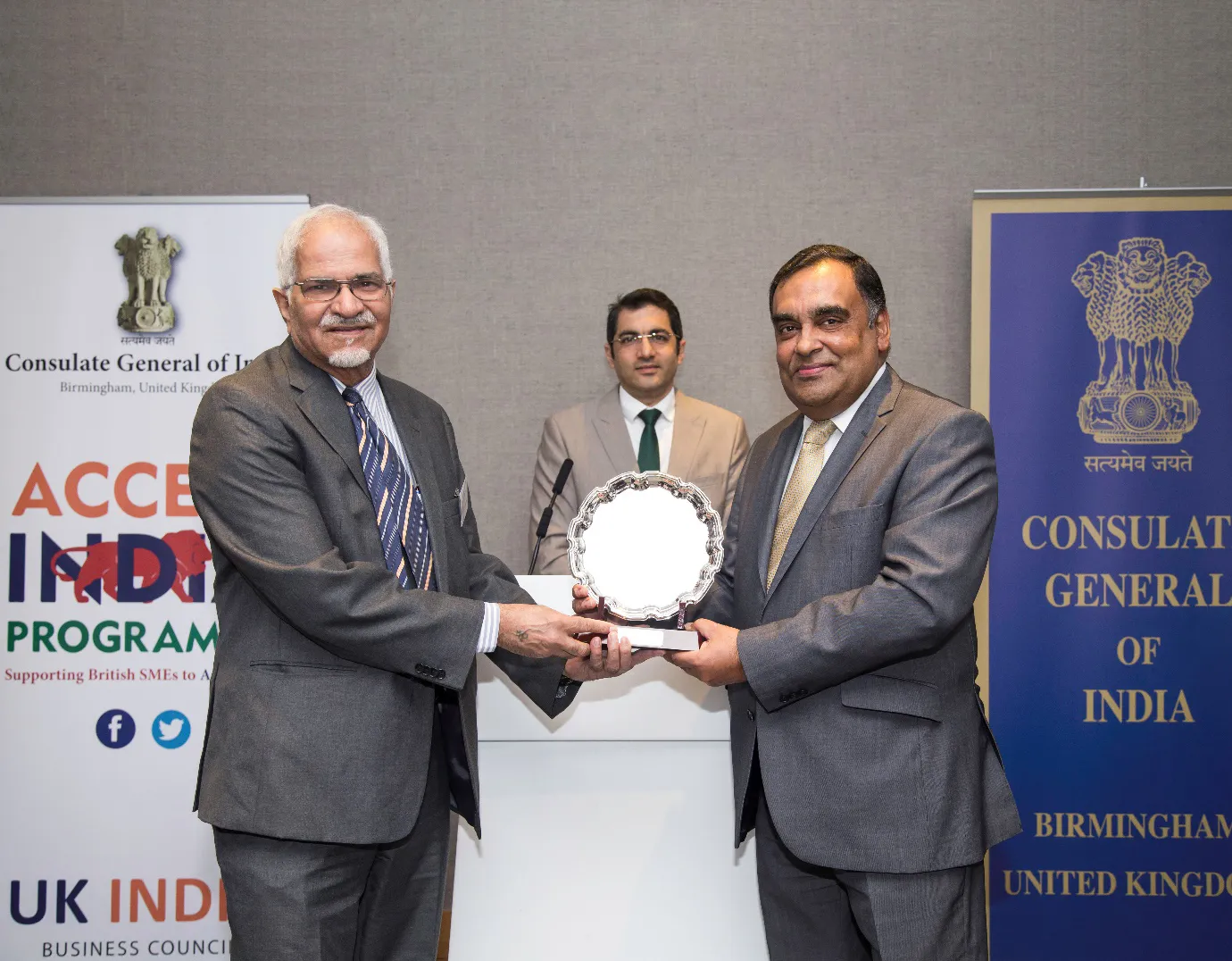
In terms of awards, Nat has been presented with many. In 2015 he received the Pravasi Bharatiya Samman from the President of India and was made a Commander of the Order of the British Empire by the Queen. Additionally, in 2007, his alma mater, London South Bank University presented him with an honorary Doctor of Engineering and Nottingham University has also presented him with an honorary Doctor of Laws. For him though, being made a Freeman of the City of Nottingham in 2012 was perhaps the closest to his heart. Despite these phenomenal achievements, Nat insists that he has only ever done these things for purely personal reasons – in fact, his interest in supporting good causes motivated him to succeed far more than he thought he could ever achieve he says. He still feels that there is still much more work to do and continues to strive to give back.
Philosophy
“Nobody owes me a living; I must work to earn it every day. Generate wealth with 100 hands and share it with 1,000 hands.”
He love…
work. He has hardly taken any holiday ever. He enjoys reading about philosophy, science and current affairs.
He suggest the youth…
to look out for that one reason to be happy, even when there are 99 reasons to be sad.
Success Mantra
Accept whatever comes your way. Just do your best each and every day.
The world doesn’t know that…
he has been in the UK for the last 53 years, yet he still proudly carries an Indian passport!
AKA
Founder Chairman, Purico Group Ltd | British-Indian industrialist Nathu R Puri
Gallery
ISBN : 9788193397695