DR DINESH C PATEL
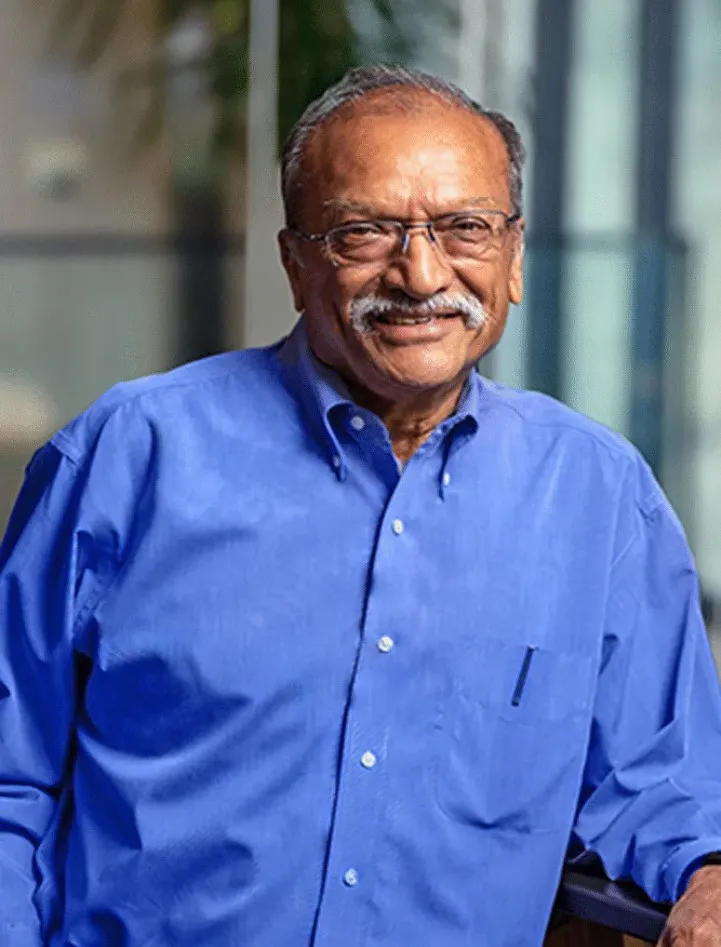
Co-founder & Executive Chairman, XENOCOR, INC
Founder & Managing Director, Patel Family Investments | Salt Lake City, Utah, US
Janma Bhumi:
Kabwe (Broken Hill), Zambia
Dharma Bhumi:
Gujarat, India
Karma Bhumi:
Utah, US
Patenting Innovation, Progress, Legacy
The ‘Dinesh’ Factor: “Innovation is the heartbeat of progress, driving us to strive for better solutions.”
THE MAN
For more than four decades, Dr Dinesh C Patel, often referred to as the ‘Godfather of Utah’s MedTech industry,’ has not only played a significant role in shaping Utah’s biotech ecosystem but has also been an influential figure in the state’s political and cultural landscapes.
Utah is Dr Patel’s chosen home. As he often says, “I am African by birth, Indian by origin, American by citizenship but a Utahn by choice.”
Dr Patel was born in 1950 in Kabwe (Broken Hill), Zambia into a Gujarati family. Originally from Vadodara, India, Dr Patel’s family lived in a segregated society where Indians lived in one area and the African locals in another. Growing up under British rule, the Patel family experienced marginalisation. “There were certain areas where you would not want to go… you did not feel very welcome.”
In spite of this, Dr Patel’s father, Chhotubhai Patel became the first non-white councillor in his city council”, instilling in Dr Patel and his siblings the value of model leadership. Their mother, Savitaben, was a calming influence, nurturing them with values of empathy and kindness. These dual influences form what Dr Patel calls “a single-minded dedication to goals shaped by compassion.”
After high school, he went to Ahmedabad, India, along with his brothers. He says, “My father wanted us to understand our culture,” he explained. It was in Ahmedabad that he realized the transformative power of education while studying pharmacy. This realisation led Dr Patel to continue his education in the United States, where he earned a Master’s in pharmacy from the Philadelphia College of Pharmacy and a Ph.D. from the University of Michigan, where he studied under Dr William Higuchi.
He would soon make Utah his home and become a biotech pioneer, philanthropist, and community icon.
THE JOURNEY
Dr Patel’s move to Utah in 1985 was fuelled by his dream of starting his own company – TheraTech. Utah had no biotech industry then and he started from scratch with just two co-founders, each contributing $40,000 of their own money. “For the first couple of years, I was the CEO, the janitor, the scientist—everything,” he recalled. But he was determined: “Failure was not an option for me.”
Within 18 months, TheraTech developed its first product and secured investment from Pfizer—an extraordinary achievement. In 1992, TheraTech went public, making him one of the first Indian-American founders to IPO a pharmaceutical company in the US. The company was later sold for US$350 million to Watson Pharmaceuticals. After TheraTech, He was a prolific builder of ecosystems: founding or investing in over 80 startups, Salus Therapeutics, Ashni Naturaceuticals, and serving as a partner at Signal Peak Ventures, among other ventures.
THE SPIRIT WITHIN
“Success is not just about achieving your own dreams; it’s also about helping others achieve theirs,” says Dr Patel. Whether building businesses, funding hospitals, or mentoring youth, his choices are guided by compassion, humility, and a desire to uplift others. “I always believe in—and that’s one thing that our family always believes in—is giving back,” he says.
His sense of service is most powerfully expressed through the Shree Chhotubhai A. Patel Hospital, a 100-bed hospital in Mota Fofalia, Gujarat, that he and his brothers built in memory of his father. “The most rewarding aspect has been the number of people served by this hospital,” he says.
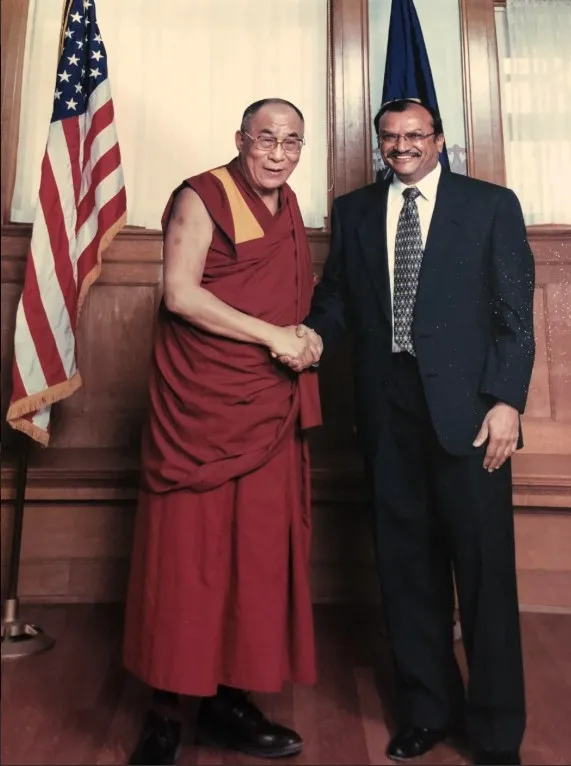
In Utah, he has not just changed the state’s biotech skyline but has also enriched its cultural soil. From the James L. Sorenson Molecular Biotechnology Building to the Utah Symphony and Opera, his presence has elevated Utah’s scientific and cultural landscape. He helped raise funds to establish the Shree Ganesha Temple and India Cultural Center in Salt Lake City and his efforts led to the construction of two Krishna temples, a Sikh Gurudwara and the Utah Tibetan Community Center.
THE LEGACY
Swami Vivekananda once said, “A man’s strength is his family.” This embodies Dr Patel’s belief, who says, “Family is the foundation of everything I have accomplished,” he often says.
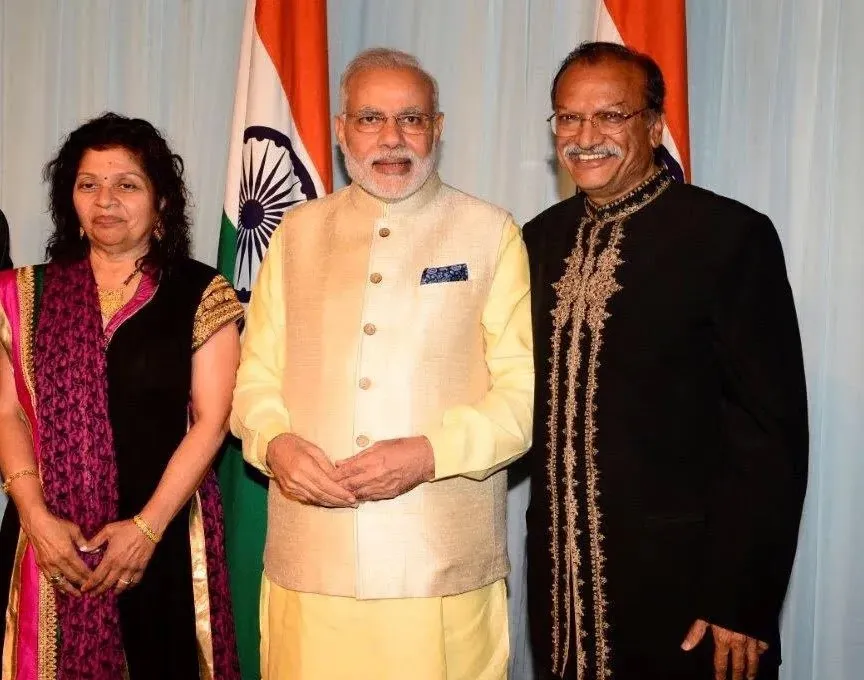
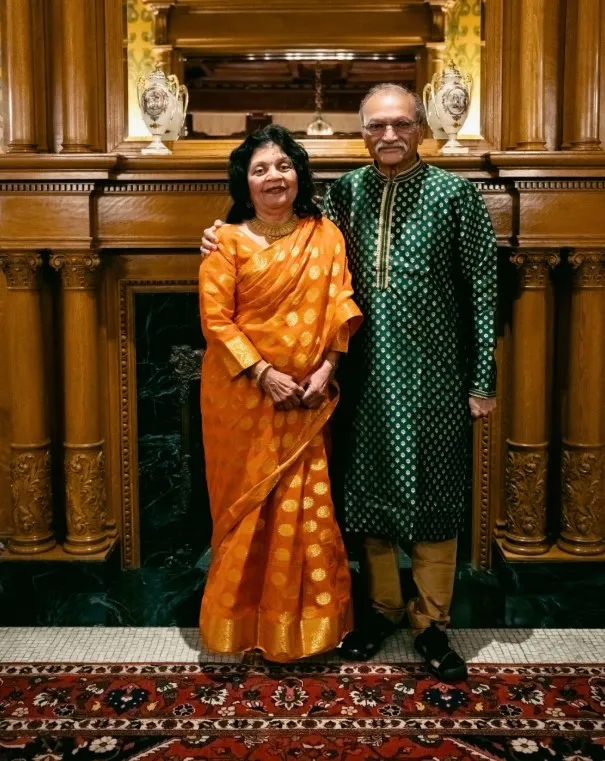
His wife, Kalpana, who accompanied him from India to the US has been his bedrock through it all. “I am grateful for her selfless dedication —it has shaped our family in profound ways,” Dr Patel shares. During the early, uncertain days of TheraTech, it was Kalpana who worked as a lab technician to help support the family, allowing him to chase dreams larger than himself. His pride in his children—Ashish and Avni—and four grandchildren is evident in every conversation.
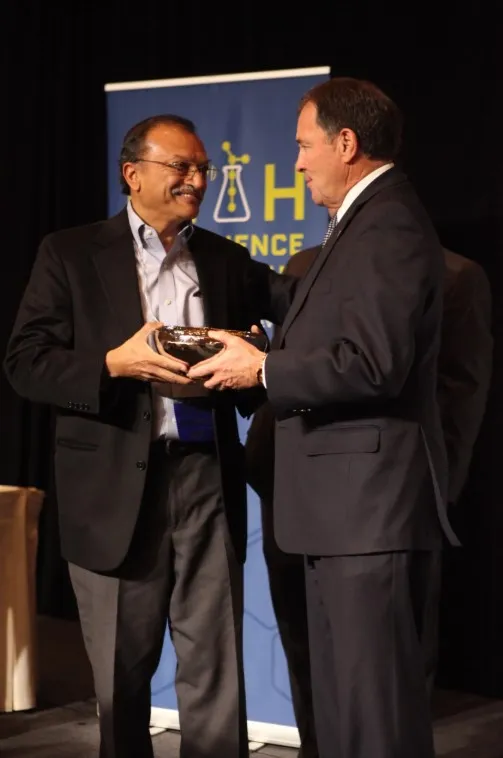
A pioneer in every sense of the word, Dr Patel’s list of accolades is long and well-earned. He received the Utah Governor’s Medal for Science & Technology in 1996, and in 2020, the state honored him with its Lifetime Achievement Medal for Science & Technology—Utah’s highest distinction in the field, to list only a few.
Dr Patel holds 15 patents in drug-delivery technology. but the trademark legacy he’s still building isn’t on paper. It is in the countless young dreamers – the entrepreneurs, the scientists, the artists – he inspires every day.
MAPPING THE INDIA WITHIN
Bharat: Then and Now
“Born in colonial Africa, Bharat was always home to me. I grew up in Zambia’s racially segregated Broken Hill, where all Indians lived together. We had a Gujarati school that kept our culture alive. My parents ensured we didn’t lose our heritage, even arranging for us to study in India. As I matured, my bond with Bharat deepened. Our philanthropic work, like building a 100-bed hospital in our ancestral village of Mota Fofalia, Gujarat, reaffirmed my identity. My understanding of Bharat evolved from cultural memory to a sense of responsibility.”
Bharatiya Values that Travelled
“Our lives have been shaped by values carried from India — hard work, service, and a strong sense of community. My father lived those values every day. This commitment to duty became the guiding principle for the family.
When I moved to the US and started a biotech company in Utah during the 1980s, there was no roadmap for what I envisioned. But giving up was definitely not part of the plan. The relentless drive, born from our Gujarati spirit of enterprise and perseverance, kept me going. My wife Kalpana’s unwavering support kept us grounded. Together, we built something greater than ourselves, fuelled by shared values.”
Generations Abroad: A New Bharatiya Identity
“When we settled in Utah, we didn’t just adapt, we brought Bharat with us. As a family, we have supported over 25 Indian organizations across the US, built temples, organized festivals, and sponsored cultural programs. A highlight was establishing the 8,300-square-foot India Cultural Center in Utah for future generations to connect with their roots.
“In 2014, my daughter’s four-day Indian wedding in Utah was a grand celebration of traditions that amazed locals. It reminded me that even far from India, we can fully celebrate our heritage. Our children may be American by birth, but they proudly embrace their Bharatiya identity too.”
Pride, Progress, and the Spirit Of Bharat
“My journey—from Zambia to Gujarat and eventually to Utah—has been driven by a profound connection to my country, a commitment to healthcare, and a passion for service. The hospital we established in our ancestral village isn’t merely a project; it’s how our pride and sense of fulfillment thrives in uplifting our country’s underserved. In Utah, we continue to foster community and preserve tradition. To me, these efforts are not mere accomplishments; they are how we sustain the spirit and essence of Bharat, no matter where we reside.”
Dreams for the Youth and Future of Bharat
“I strongly believe that there is immense potential for innovation in India’s rural healthcare and biotechnology sectors, particularly through partnerships that integrate public systems, private entrepreneurs, and the Indian diaspora. Collaboration with institutions like the University of Utah, which trains physicians and nurses in capacity-building efforts at Mota Falia, provides a scalable model. Combining global resources with local knowledge can lead to impactful results.
“To the youth of India, I would say this: It is important to stay connected to Indian values, strive for global excellence, and contribute positively to society. Education, opportunity, and success are valuable assets, but their true significance lies in using them to create meaningful change and uplift others. This is the true spirit of being Bharatiya, regardless of where you choose to live.”
Patenting Innovation, Progress, Legacy
The ‘Dinesh’ Factor: “Innovation is the heartbeat of progress, driving us to strive for better solutions.”
THE MAN
For more than four decades, Dr Dinesh C Patel, often referred to as the ‘Godfather of Utah’s MedTech industry,’ has not only played a significant role in shaping Utah’s biotech ecosystem but has also been an influential figure in the state’s political and cultural landscapes.
Utah is Dr Patel’s chosen home. As he often says, “I am African by birth, Indian by origin, American by citizenship but a Utahn by choice.”
Dr Patel was born in 1950 in Kabwe (Broken Hill), Zambia into a Gujarati family. Originally from Vadodara, India, Dr Patel’s family lived in a segregated society where Indians lived in one area and the African locals in another. Growing up under British rule, the Patel family experienced marginalisation. “There were certain areas where you would not want to go… you did not feel very welcome.”
In spite of this, Dr Patel’s father, Chhotubhai Patel became the first non-white councillor in his city council”, instilling in Dr Patel and his siblings the value of model leadership. Their mother, Savitaben, was a calming influence, nurturing them with values of empathy and kindness. These dual influences form what Dr Patel calls “a single-minded dedication to goals shaped by compassion.”
After high school, he went to Ahmedabad, India, along with his brothers. He says, “My father wanted us to understand our culture,” he explained. It was in Ahmedabad that he realized the transformative power of education while studying pharmacy. This realisation led Dr Patel to continue his education in the United States, where he earned a Master’s in pharmacy from the Philadelphia College of Pharmacy and a Ph.D. from the University of Michigan, where he studied under Dr William Higuchi.
He would soon make Utah his home and become a biotech pioneer, philanthropist, and community icon.
THE JOURNEY
Dr Patel’s move to Utah in 1985 was fuelled by his dream of starting his own company – TheraTech. Utah had no biotech industry then and he started from scratch with just two co-founders, each contributing $40,000 of their own money. “For the first couple of years, I was the CEO, the janitor, the scientist—everything,” he recalled. But he was determined: “Failure was not an option for me.”
Within 18 months, TheraTech developed its first product and secured investment from Pfizer—an extraordinary achievement. In 1992, TheraTech went public, making him one of the first Indian-American founders to IPO a pharmaceutical company in the US. The company was later sold for US$350 million to Watson Pharmaceuticals. After TheraTech, He was a prolific builder of ecosystems: founding or investing in over 80 startups, Salus Therapeutics, Ashni Naturaceuticals, and serving as a partner at Signal Peak Ventures, among other ventures.
THE SPIRIT WITHIN
“Success is not just about achieving your own dreams; it’s also about helping others achieve theirs,” says Dr Patel. Whether building businesses, funding hospitals, or mentoring youth, his choices are guided by compassion, humility, and a desire to uplift others. “I always believe in—and that’s one thing that our family always believes in—is giving back,” he says.
His sense of service is most powerfully expressed through the Shree Chhotubhai A. Patel Hospital, a 100-bed hospital in Mota Fofalia, Gujarat, that he and his brothers built in memory of his father. “The most rewarding aspect has been the number of people served by this hospital,” he says.
In Utah, he has not just changed the state’s biotech skyline but has also enriched its cultural soil. From the James L. Sorenson Molecular Biotechnology Building to the Utah Symphony and Opera, his presence has elevated Utah’s scientific and cultural landscape. He helped raise funds to establish the Shree Ganesha Temple and India Cultural Center in Salt Lake City and his efforts led to the construction of two Krishna temples, a Sikh Gurudwara and the Utah Tibetan Community Center.
THE LEGACY
Swami Vivekananda once said, “A man’s strength is his family.” This embodies Dr Patel’s belief, who says, “Family is the foundation of everything I have accomplished,” he often says.
His wife, Kalpana, who accompanied him from India to the US has been his bedrock through it all. “I am grateful for her selfless dedication —it has shaped our family in profound ways,” Dr Patel shares. During the early, uncertain days of TheraTech, it was Kalpana who worked as a lab technician to help support the family, allowing him to chase dreams larger than himself. His pride in his children—Ashish and Avni—and four grandchildren is evident in every conversation.
A pioneer in every sense of the word, Dr Patel’s list of accolades is long and well-earned. He received the Utah Governor’s Medal for Science & Technology in 1996, and in 2020, the state honored him with its Lifetime Achievement Medal for Science & Technology—Utah’s highest distinction in the field, to list only a few.
Dr Patel holds 15 patents in drug-delivery technology. but the trademark legacy he’s still building isn’t on paper. It is in the countless young dreamers – the entrepreneurs, the scientists, the artists – he inspires every day.
MAPPING THE INDIA WITHIN
Bharat: Then and Now
“Born in colonial Africa, Bharat was always home to me. I grew up in Zambia’s racially segregated Broken Hill, where all Indians lived together. We had a Gujarati school that kept our culture alive. My parents ensured we didn’t lose our heritage, even arranging for us to study in India. As I matured, my bond with Bharat deepened. Our philanthropic work, like building a 100-bed hospital in our ancestral village of Mota Fofalia, Gujarat, reaffirmed my identity. My understanding of Bharat evolved from cultural memory to a sense of responsibility.”
Bharatiya Values that Travelled
“Our lives have been shaped by values carried from India — hard work, service, and a strong sense of community. My father lived those values every day. This commitment to duty became the guiding principle for the family.
When I moved to the US and started a biotech company in Utah during the 1980s, there was no roadmap for what I envisioned. But giving up was definitely not part of the plan. The relentless drive, born from our Gujarati spirit of enterprise and perseverance, kept me going. My wife Kalpana’s unwavering support kept us grounded. Together, we built something greater than ourselves, fuelled by shared values.”
Generations Abroad: A New Bharatiya Identity
“When we settled in Utah, we didn’t just adapt, we brought Bharat with us. As a family, we have supported over 25 Indian organizations across the US, built temples, organized festivals, and sponsored cultural programs. A highlight was establishing the 8,300-square-foot India Cultural Center in Utah for future generations to connect with their roots.
“In 2014, my daughter’s four-day Indian wedding in Utah was a grand celebration of traditions that amazed locals. It reminded me that even far from India, we can fully celebrate our heritage. Our children may be American by birth, but they proudly embrace their Bharatiya identity too.”
Pride, Progress, and the Spirit Of Bharat
“My journey—from Zambia to Gujarat and eventually to Utah—has been driven by a profound connection to my country, a commitment to healthcare, and a passion for service. The hospital we established in our ancestral village isn’t merely a project; it’s how our pride and sense of fulfillment thrives in uplifting our country’s underserved. In Utah, we continue to foster community and preserve tradition. To me, these efforts are not mere accomplishments; they are how we sustain the spirit and essence of Bharat, no matter where we reside.”
Dreams for the Youth and Future of Bharat
“I strongly believe that there is immense potential for innovation in India’s rural healthcare and biotechnology sectors, particularly through partnerships that integrate public systems, private entrepreneurs, and the Indian diaspora. Collaboration with institutions like the University of Utah, which trains physicians and nurses in capacity-building efforts at Mota Falia, provides a scalable model. Combining global resources with local knowledge can lead to impactful results.
“To the youth of India, I would say this: It is important to stay connected to Indian values, strive for global excellence, and contribute positively to society. Education, opportunity, and success are valuable assets, but their true significance lies in using them to create meaningful change and uplift others. This is the true spirit of being Bharatiya, regardless of where you choose to live.”
BACK TO THE FUTURE – IN FIVE MOMENTS
Food Cravings
THEN
We grew up with simple, home-cooked Gujarati vegetarian meals—a comforting staple of our daily life.
NOW
Our taste buds have travelled the world! We enjoy all vegetarian dishes from Mexican and Italian to Thai and Chinese cuisines. South Indian dosas and idlis are favorites, as is hearty Punjabi fare.
Sport Spirit
THEN
Childhood was filled with outdoor fun—soccer, cricket, and tennis kept us on our toes and out in the sun.
NOW
Today, I’m an enthusiastic fan of American college football and basketball; I’m even a season ticket holder for the Utah Jazz. Golf is my current go-to sport. I used to love skiing until a knee injury slowed me down.
Music Tastes
THEN
We had limited access to Indian or Bollywood music growing up, so most of what we heard came through local radio stations.
NOW
Now, it’s a world of sound—from rap to classical, bhajans to Bollywood. As music lovers, we support and sponsor concerts across India’s musical spectrum — Gujarati, Hindi, Tamil, Telugu, Bengali— you name it.
Holiday Life
THEN
In Zambia, holidays were mostly spent at home. A trip to India every few years was ‘the’ big event.
NOW
The globe is our playground—we love to travel and explore new destinations across continents.
Leisure Habits
THEN
Free time meant hanging out with friends and making memories in our own backyard.
NOW
Leisure today looks a little different—golfing, exploring new places, and soaking in different cultures now bring me joy.
AKA
Dr. Dinesh C. Patel Executive Chairman XENOCOR | XENOCOR Inc Co-founder Dr. Dinesh Patel | Indian-American Business Leader Dr. Dinesh Patel