Kinza Jamal

Birthplace:
Meerut, Uttar Pradesh
Residence:
New Delhi, India
Qualification:
Master’s in Gender studies, Social Work, Jamia Millia Islamia
Inspiration:
Her mother; and Fatima Sheikh, one of India’s earliest Muslim women educators
UNAPOLOGETICALLY, INTERSECTIONAL
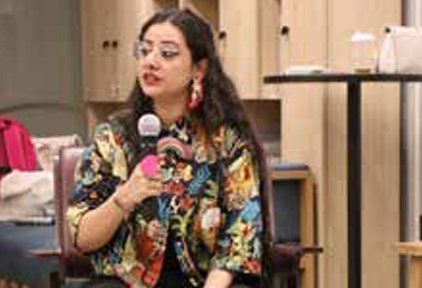
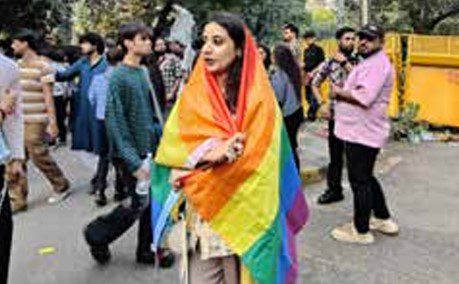
As a first-generation learner from a joint family, Kinza Jamal channels her lived experiences of Islamophobia, casteism, queerphobia, and gender-based violence to disassemble systemic oppression. She trains, advocates, and builds support for marginalized identities across India. Kinza is very clear about who she is: Queer, a Pasmanda Muslim, neurodivergent, and an intersectional feminist. Fiercely authentic, Kinza has what the French would describe as ‘fougue’ – spirited energy that fuels her every move – as an educator, writer, and activist.
Understanding Kinza Jamal begins with understanding the identities she embraces and how they inform her very move. Kinza’s childhood was spent in Meerut, Uttar Pradesh in a joint family. The 25-strong Pasmanda Muslim household was patriarchal where gender oppression was the norm. Yet, queerness was organic for Kinza. She says, “I never looked at it as something shameful or felt disgusted about who I was.”
This was in part because of her mother’s quiet resistance and her father’s silent support to both her and her sibling, who is also queer.
Another part of her identity is that of a Pasmanda Muslim and as such she has to face both Islamophobia and casteism for as long as she can remember. The trauma of having to go without lunch because her food preferences were “dirty” or the microaggression of a backhanded compliment such as ‘Oh you don’t look Muslim’ were her earliest introductions to Islamophobia.
If that was not enough, being from a Dalit community meant further social and economic marginalisation not just from the broader society but also within the Muslim community entrenched in caste hierarchies.
For Kinza, who is also neurodivergent, it is not just about being only queer or only Pasmanda Muslim, it is about all these identities coming together to make her who she is and her worldview.
Lived Experiences As Compass
From navigating discrimination in second grade, to finding herself in an abusive relationship with an upper-caste man, where she was subjected to slurs and violence, Kinza’s lived experiences are her compass. For her, gender studies were not an academic choice. Kinza began educating herself to support her elder queer sibling. While doing so, she found resonance in intersectional feminism through Dalit and Black feminist ideologies.
This and the early acts of erasure became the foundation of her path – pursuing gender studies and becoming a fierce voice for the marginalized.
Academia helped her in articulating what she always knew in practice. “Intersectionality existed in my life before I had the words for it.”
From Constant Exclusion to Rare Inclusion
Kinza’s experiences at Amity University were a mixture of casteist remarks and classist judgement. In contrast, she found that rare inclusive space in Jamia Millia Islamia, where she was pursuing her Masters in Gender Studies.
Recalling her time there Kinza says, “The space was culturally rich, and accessible. There were people from different backgrounds and interaction with them became a lesson. Of course, the curriculum itself was transformative. It looked at gender from every angle – gender in media, gender in health, gender in economics, religion — it became an intersectional lens by which I could view everything. Every section of society is gendered, and there is violence, but we don’t acknowledge it. Jamia taught me to see that aspect.”
Of Justice, Care, & the Quiet Labour of the Marginalised
Kinza finds that ‘Cancel Culture’ obfuscates any important discourse and believes that it is crucial that we shift the conversation toward justice and responsibility, especially within the social justice sector. Kinza challenges the elitism of so-called intellectual activism.
“We cannot create echo chambers — four people talking intellectual stuff over wine or tea. We need to reach people who actually need this knowledge.”
She is also cognizant of the fact that the marginalised often have to do the heavy lifting of educating the privileged. “For people like me, from marginalized identities, unfortunately, we don’t have the privilege to say, ‘Go educate yourself’. It is labour that has voluntarily or involuntarily landed on our shoulders.”
She makes a very pertinent point when she says that for justice to work, it must be grounded in accessibility, shared responsibility, and practical care.
Decolonising the Self & Collective Liberation
Collective liberation begins with decolonisation. Kinza believes they are both necessary tools. In order to get the wheels of equity and justice in motion, she emphasises the power of asking deeper questions. “When we talk about collective care and justice, we must ask: what is ‘collective’? Is it just upper-caste, upper-class people hanging out together? Or Muslims hanging out together? Dalits? That’s not collective liberation.”
She explains, “Collective means collective accountability and transparency — not just from people like me, but from people in power. Because capitalism and colonialism don’t wait for identity to be targeted. They are coming for everyone.”
She emphasizes that we are all participants in these systems. “We are all colonized. We all have internalized capitalism. We see people as products, and when they don’t function the way we’d like them, we discard them.”
Decolonisation, she says, has to start from within. “If we really want to care, we need to check our own colonial practices, and our capitalistic behaviours towards each other.
She adds, “If my house is burning today, yours could be next. Capitalism doesn’t discriminate — and colonial systems still shape how we relate, how we work, how we exclude. Collective liberation is about unlearning all of that, together.”
Her call is simple, yet radical: share knowledge freely, break the cycles of gatekeeping, end transactional relationships, and centre lived experiences. “Liberation is not just about tearing down systems,” she says. “It’s about building relationships where no one is disposable.”
She adds, “Instead of networking’ we need to build genuine friendships rooted in care, grief, and resistance.”
Navigating Trauma Work, Rest, & Resistance
“People who are caregivers or social workers are seen as inhuman not seen as people who get triggered,” Kinza begins, shedding light on a harsh reality faced by those who work intimately with trauma, especially gender-based violence (GBV). “There is no space for social workers to unburden or seek mental health support. We are often told, ‘You chose this profession. This comes with the job.’”
She adds, This is a conversation that needs to happen. It has to go beyond the performative wellness retreats, to include travel allowance, health insurance, mental health support.”
So how does Kinza find the support she needs? She says, “I found it in fellow marginalized people — Dalit, queer, disabled — they shared love, food, knowledge.” Her support system is built on mutual aid and the ability to rest when the need arises. She says, “If I’m hired for 8 hours, I work those hours and not beyond that. Rest is about setting boundaries and self-care. “Rest is switching off your phone and talking to your friends.”
As a marginalised queer Pasmanda Muslim activist, Kinza believes that rest is vital because it forms the foundation of resistance and the reclaiming of humanity in a system that demands sacrifice without care.
For Kinza, resistance is a way of being and her message to the queer community is to remember that every resistance against systemic oppression is a ‘Queer Resistance’.
Radical as it sounds it is rooted in a very simple premise that we are all in it together.
The message resounds clearly in Kinza’s dulcet, yet firm voice as much as it echoes in her confidence to be all that she wants to be. After all she says, “Queer means fluid. It means I can be anything and everything I want.” And she is.
LANGUAGE OF ACCESSIBILITY
Kinza has developed intersectional training resources for adolescents across India, demystifying laws like POCSO with accessible language. This is something she carries in her SRHR pedagogy as well. The goal is not just about using jargon, but it is also about unpacking the caste, class, and religious realities shaping bodily autonomy and explaining it in that context.
DECODING EFFECTIVE ALLYSHIP
Collective accountability and effort brings collective liberation and Decolonizing the self is the first step towards this. It begins with unlearning internalized capitalism and questioning who we include in our idea of ‘community.’
FIVE FACTS ABOUT KINZA
Kinza loves Palak Paneer.
Her favourite books are ‘Bhimyana’, a graphic novel on the life of Dr. BR Ambedkar; ‘The Master’s Tools Will Not Dismantle the Master’s House’ by Audre Lorde, and ‘Gender and Nation’ by Nira Yuval-Davis.
Her guilty pleasure is watching trash TV.
Her favourite series are ‘The Handmaid’s Tale’ and ‘Sense8’.
Few people know that Kinza is a self-taught painter and liberation writer.