
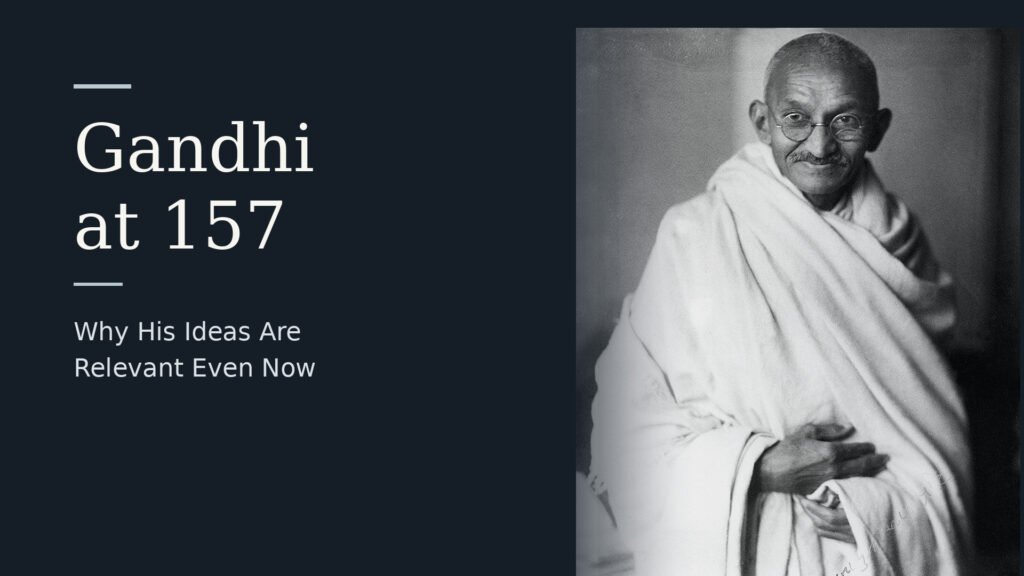
If he were alive, he’d be 157-years-old on 2 October 2026. Mahatma Gandhi – Father of the Nation – would be dealing with intruders of a different ilk – Artificial Intelligence going rogue, truth being twisted to suit narratives, wars being fought on social media, chaos everywhere.
We suppose he would not be averse to the progress. He had always been in favour of it but not, we suspect, at the cost of values and morals that seem to be degrading.
So, it brings us to ask a simple question? Though he is not with us anymore, are Gandhi and his ideals still relevant today?
The answer lies somewhere in between. Maybe not all his principles would find a fit in this century. But most of them would. Here are five.
1. Truth & Disinformation
Gandhi believed that Satya (truth) is inseparable from public life. And, if that was relevant then, it is even more so now.
The World Economic Forum’s Global Risks Report 2026 places misinformation and disinformation among the leading risks across much of the world.
Gandhi’s satyagraha therefore offers something more sophisticated than the instruction not to lie. It asks whether truth can remain the organising principle of public discourse when falsehood is faster, cheaper and often more seductive.
The Modern Dilemma: With misinformation at an unprecedented scale, how does truth find its way?
The Gandhian Lens: Satyagraha – something as simple as verifying truth before amplifying.
2. Non-violence & Cost of War
The United Nations chose Gandhi’s birthday as the International Day of Non-Violence (Ahimsa) and explicitly recognises the “universal relevance” of the principle. While it might be difficult to relate with the philosophical aspect of it, perhaps the fiscal argument might appeal to this materialist world.
Think about it. Global military expenditure reached a record US$2.887 trillion in 2025, according to the Stockholm International Peace Research Institute — the eleventh consecutive annual increase and 41 per cent higher than a decade earlier. Now, if we were to opt for non-violence, how much could we save and where could the collective savings be most useful?
For Gandhi non-violence was about resistance without being violent. He did not ask for passivity but asked that we understand that ends could not justify the mean.
The Modern Dilemma: When power is measured by the capacity to destroy, can restraint still be seen as strength?
The Gandhian Lens: Ahimsa asks us to reconsider power itself. Restraint requires more courage than retaliation.
3. The Culture of Excess & Conscious Minimalism
Gandhi always propagated minimalism – understand when enough is enough. Many of us struggle with that don’t we thanks to one-click shopping temptations, fast fashion, and perpetual upgrades.
The environmental data is getting increasingly worrying. The UN Environment Programme reports that extraction of the Earth’s natural resources has tripled over the past five decades. Without significant change, material extraction could rise another 60 per cent by 2060. To translate Gandhi’s ideals in modern vocabulary, think of the carbon footprint we could reduce if we just practised restraint in buying. Circular economies could mean a cycle of good for everyone.
The Modern Dilemma: Is more always better?
The Gandhian Lens: Live simply. Consume consciously.
4. Welfare of All & Age of Self-Interest
Gandhi believed in Sarvodaya (welfare of all )— and Antyodaya (uplifting those most in need).
But can we really think about others? We are becoming an increasingly individualistic race, with apathy taking over sympathy. Empathy is a big ask!
The World Bank reported in 2024 that 44 per cent of humanity lived on less than US$6.85 a day. Now, no one is asking that we give up all our wealth. But if we could help even one person, then we could beat these grim odds, don’t you think?
Sarvodaya tells us that wealth comes with social responsibility. It finds its echo in philanthropy, responsible capitalism and impact investing.
The Modern Dilemma: Is success only about ourselves?
The Gandhian Lens: Create wealth. Share it. It means more when opportunity travels beyond us.
5. Human Dignity & Age of Inequality
Dignity is not about big titles or fancy things. Gandhi always said that it should begin with the basics — cleanliness, sanitation, labour and the conditions in which people lived.
Data shows that things have not changed much in that regard. The World Health Organization reports that 3.4 billion people still lack access to safe sanitation, while inadequate water, sanitation and hygiene contribute to 1.4 million deaths annually. Gandhi’s message was practical: progress means little unless it improves everyday life.
The Modern Dilemma: Can progress exist without dignity?
The Gandhian Lens: Think big. Improve everyday.
The Man. His Ideals
Mahatma Gandhi would be the first to admit that he has flaws. So, treating him as a near-God would only do his legacy more harm.
Truth, dialogue, minimalism, restraint, prosperity for all – Gandhi’s perspective on these ideas could not be more relevant today.
And, perhaps the best tribute we could pay to Mahatma Gandhi is to find a place for his ideas in our times.