
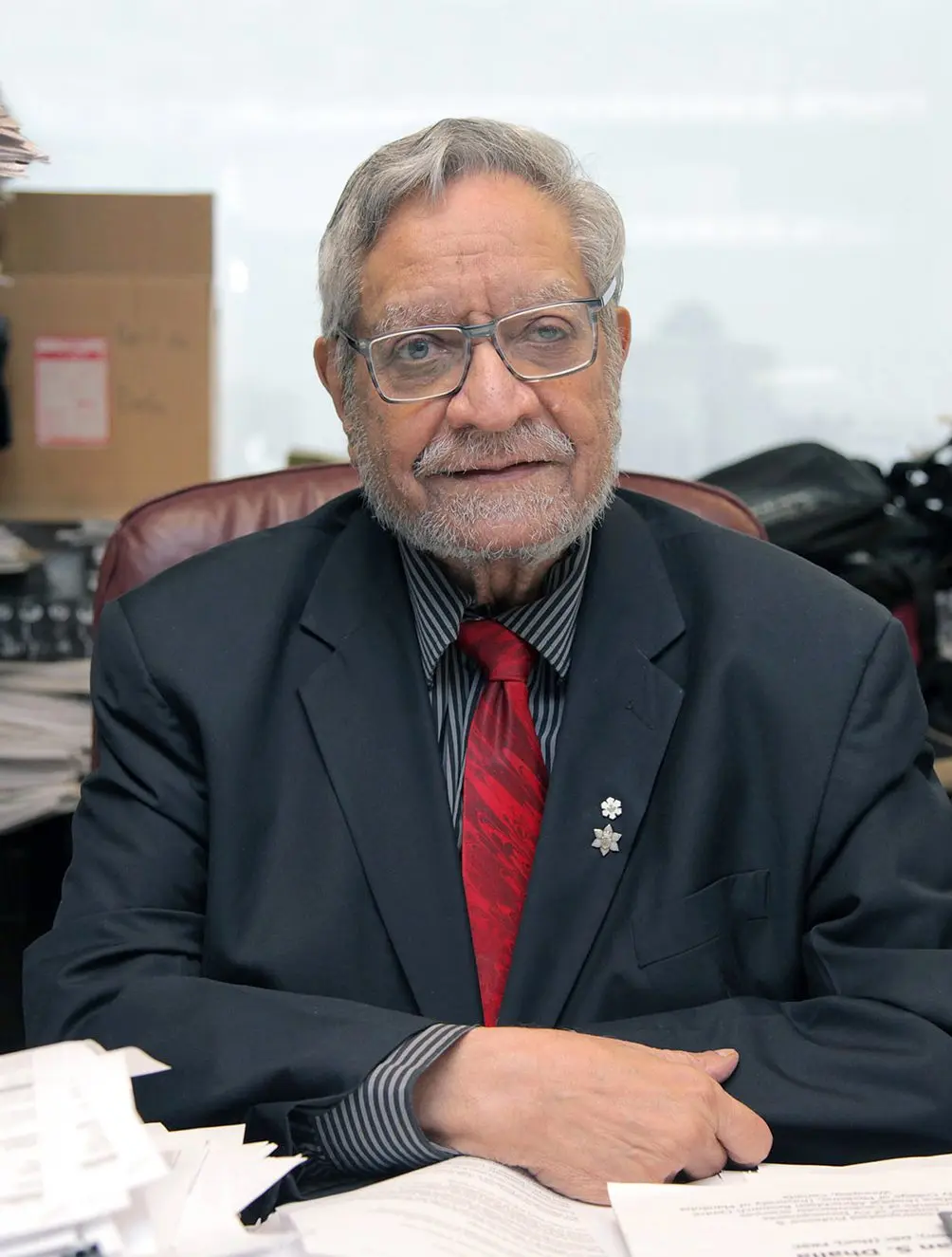
Dr. Dhalla was born on 10 October 1936, though he also admits back then the date of birth didn’t matter much. Proud of his happy-go-lucky and fairytale childhood, he and his six other siblings were raised in love, affection and respect. His parents, Maya Devi and Mulkhraj Singh, did not attend any school. Mulkhraj was 11 when his father expired and had to shoulder all the responsibilities. No wonder that Naranjan till date idolises him, inheriting communication and personal relationships skills from him. He recalls merrily, “Building relationships was my father’s greatest strength. Villagers called him Shahji because of his demeanour. We had no time for mischief or anything because the welfare of people was our main concern; they also were too fond of us too”. Remembering his mother, he divulges, “She was too committed towards the family’s well-being. We had a lot of extended family, our home was always full of people and my mother was always a warm host. Compassion is something I inherited from her.”
When the bubble bursts, reality glares!
Naranjan becomes nostalgic sharing about his childhood. “I have travelled the entire world but nothing could be as mesmerising as my childhood. There was, at that time, a primary school in the village; for middle classes we went about two miles away; for my high-school, I went 4–5 miles away in another village. All that was resplendent beyond words.”
His father had always been generous—he bolstered people socially, economically and personally and went out of his way to ensure that people were at peace with their lives. It gave Naranjan the illusion of them being financially well-off as well. Thus, he was quite a spendthrift and led an extravagant lifestyle during his Bachelors of Science in Physics and Chemistry at Khalsa College in Amritsar. He enjoyed entertaining people; his collegemates called him shahenshah. Gradually, he tried finding the real context of life. He started thinking about it with a very different vision and comprehended that there was nothing special about him. Coming from a fairytale background, it wasn’t acceptable to him! Although he did acknowledge that his family wasn’t rich, it made him ponder on a lot of things. Shocked, he decided to do something big, something to bring his family out of it all. He was raised to be a special person; he just had to do something special! And, it is correctly said, if your vision is clear and you dream with eyes wide open, your dreams are achieved, sooner or later. Something similar happened with Naranjan. A fan of the legendary Bollywood actor, Raj Kapoor, his interests lay in Bollywood and the health industry; he chose to work on the latter and enjoy the former. He had often noticed that the health of people was one of the most ignored aspects.
He was very much convinced that India’s resources weren’t tapped properly and so opted to research. While doing his apprenticeship in Amritsar, Dr. Chaman Lal Malhotra, who was working in a medical college in New Delhi, was impressed by Naranjan and invited him to work with him. And hence, his professional journey started with research on indigenous Ayurvedic drugs, Brahmibooti and Withania Ashwagandha, for four years.
Having good interpersonal skills, he got the opportunity to make contacts with the people who were doing great in the field. In fact, he rapidly rose to the level of Assistant Research Officer. Remembering those days, he says, “Dr. B.R. Madan from Bikaner, who saw me working, suggested that I study at the University of Pennsylvania, USA, and so sent my CV there. I was accepted with a very hefty scholarship. I was the first Asiatic student in that school where in 1963, I received an M.Sc. in Pharmacology. Later, I went to University of Pittsburgh and obtained a Ph.D. in Pharmacology in 1965. I enjoyed good relationships with professors in the USA and had an extraordinary experience.”
That was then. In 1968, Dhalla moved to Canada and directed the development of Canadian Heart Research Centre of Excellence, which came in operation in 1978. Later in 1987, he founded the Institute of Cardiovascular Sciences for training future generations of investigators. Having served the International Society for Heart Research (ISHR) as secretary general (1972–1987) and president in various capacities (1987–1996), he also founded the Academy of Cardiovascular Sciences in 1996 for promoting education and research throughout the world including India.
In 1997, he was inducted as a member of the Order of Canada and later as member of the Order of Manitoba for his contribution to cardiovascular research. A fellow of the Royal Society of Canada since 2000, he was awarded several honorary doctorate degrees, like one from Panjab University, Chandigarh, in 2009.
The source behind!
While popping a question about his wife, Ranjit’s contribution, he says, “She has been a great source of encouragement and inspiration to me ever since we are together. In fact, when I was in a bad shape upon losing our eldest son, Samraj, to cardiac arrest in 2008 and when all of my brothers expired, she really helped me in putting things back in order. She is a wonderful and simple person. Social service has been her call through and through. She was a high-school teacher, but she did not pursue her career because helping me was more vital for her.” The Dhalla couple draws strength from their four children, Sonny, Sonia, Vikram and Romel. All of them are highly educated and settled in different parts of Canada and the USA.
Naranjan welcomed all his brothers to Canada; their families are now well-settled in this country. Indeed, one of his brothers, Kalwant, also his best friend, joined him in his laboratory as his advisor. Naranjan was shocked beyond imagination when they lost him in 2010.
A strong believer in the philosophy of Guru Amar Das, Dhalla was always sure he wanted to do something for people at large. He is close to his motherland and has always willingly accepted invitations of lectures to Indian students – the future of the nation. When he completed his education and was on his way to be well-settled, his parents wanted him to head back to India. However, Naranjan knew there was a long way to go and decided to continue his learning in Canada and serve India. He founded the Punjab Foundation of Manitoba in 1988. It was created to build a cultural centre for social programmes, with a Punjabi school and a day care centre as well as a community hall for Indians. Ranjit was the board chairperson. The Punjab centre was made for social and cultural activities. He also formed the Indo Canadian Cultural Heritage Association (ICCHA) with the objective of recognising excellence in education for young people and providing incentives to people of Indian origin.
He has always had a knack of training people and trained 163 graduate students, postdoctoral fellows, visiting scientists. Not only has he contributed to Canada, but to India as well. He established an award for The Best Teacher in brother’s name at the Punjab Academy, Patiala. Since his father believed in education, he provides scholarships to 18 students in his village every year. Indeed, he set up sections of the International Society for Heart Research and International Academy of Cardiovascular Sciences in India for promoting heart health and education.
He smiles as he quotes a line from Punjabi poetry, “Hawaye bil muqabil se kyun ghabraye okab, ye toh chalti hai tujhe uncha udane ke liye. I had to deal with many people who never liked Indians and it didn’t bother me because I have always believed—spit on my face, say I am no good and that will give me more impetus. I have never wanted people to admire me”.