
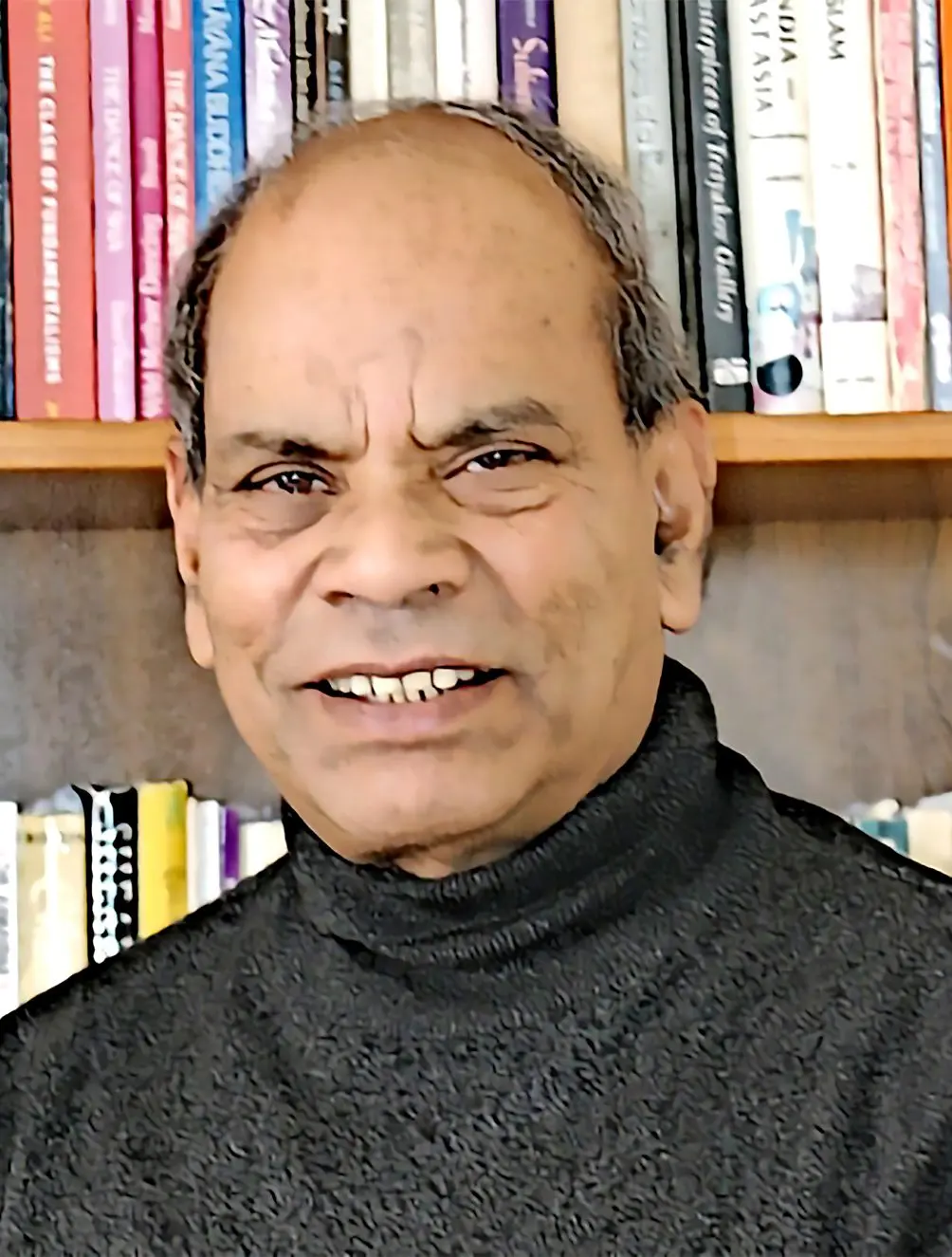
In 2021, an intelligence test was developed by Indians for Indians & released for distribution. They called it the Brain-based Intelligence Test (BBIT). BBIT has enabled better curriculum development that enhances the cognitive processes – the foundation of academic learning, such as reading and math. At the same time, it also makes the diagnosis of impairment of cortical functions as in stroke, epilepsy and traumatic brain injury easier. The team was led by a psychologist who has studied Indian minds and behaviours for several years and today is an internationally recognised expert.
Jagannath was born in Puri on 20 January 1931, when the Indian independence movement was at its peak. He grew up when patriotic movements against the British swept over rural villages, towns and cities. Gandhi’s call for swaraj moved millions. Following him, his parents followed the virtues of simple living and high thinking. His father, Biswanath Das, an accountant in the post-office, was an austere Gandhian and had instilled the same values in all his six children. “We kids weren’t allowed to wear shoes – it was slippers and khadi clothes for us,” he remembers.
Revisiting his childhood, Jagannath says, “My father was a matriculate and was brilliant in English but couldn’t get higher education and hence decided that he would put all his children in colleges, come what may. My mother was a good partner and shared his ideals. She always encouraged us to be extraordinary and above all, a good human being.” All his siblings are well-accomplished: Jadunath is a doctorate in medicine, Radhanath Ph.D. in engineering and sisters Annapurna, Satyabhama and Nita have a master’s degree to say the least.
Jagannath grew up entirely in Cuttack. He went to the Ranihat School and was always a bright and disciplined student who was inclined towards reading books of all spheres. He initially wanted to study humanities in college but one of his professors, Prof. Radhanath Rath, influenced him to study psychology instead. He graduated from the British-run college, the Ravenshaw College, the best college in Orissa (now Odisha) of its times, in 1951 and went on to pursue postgraduation in experimental psychology from the Patna University from 1951 to 1953. Language became a challenge as Jagannath moved to a Hindi-prime state, Bihar, though Hindi was his third language until now, and suddenly, it had become the primary language for him. Nevertheless, he sailed through. Two years later, he was appointed as a lecturer in psychology at the Utkal Utkal University, Orissa.
Wearing his heart on sleeves
Love entered his life and culminated in marriage without warning. Geeta was a student of psychology (honours) in Ravenshaw College where he was a lecturer there. Happiness reflects on his face, as he shares, “She was from a zamindar family, rich compared to my father’s economic class, and her parents were initially reluctant when we first took the proposal. But all’s well that ends well. We were blessed with our son, Satya. In 1955, I won a scholarship from the government of India to study at the Institute of Psychiatry, University of London. We had to leave Satya with Geeta’s family; leaving our eight-month-old infant was perhaps the most difficult decision we had to make.” She got admission into the University of London for postgraduation in psychology under Prof. Hans Eysenck, who was Jagannath’s Ph.D. supervisor too.
London was a different experience altogether – something that Jagannath didn’t expect. He noticed the lives of black people in 1955.
Following his doctorate degree at the end of 1957, he went back to Utkal University to continue his job as a lecturer. But it couldn’t satisfy him as it was a small university in a small place with a limited scope of research. However, against all odds, he had written and published some 35 papers in international journals of psychology that got him an invitation from the Kennedy Foundation to be a visiting professor at Vanderbilt University and next at the University of California, Los Angeles, for 1963–1965 before returning home to his job in Utkal University. He says, “With my increasing frustration for the lack of research opportunities at Utkal, luckily in 1968, I got an invitation from the University of Alberta, Canada, for a faculty position at its newly established centre, then the Centre’s Director,” where he has been since where he is now an emeritus professor.
A lot of his success, he says, is also pure blessing from above.
Going down the memory lane, he says, “Our daughter, Sheela, brought in luck. Three days after her birth, the letter of invitation from the University of Alberta arrived while both of us had faculty positions at Utkal. It was a happy moment for me, but I didn’t want to leave behind my family. Geeta knew I wasn’t happy at Utkal and left her job to accompany me. Can I be thankful enough to her? My father was elated to see me expand my wings and fly. But it wasn’t a piece of cake for the two initial years in Edmonton Alberta. Winters were harsh, temperature dropping down to −30 degrees. Coming from a warm location where winters were a pleasant +15 degrees, we didn’t know if we could survive. Geeta didn’t work for three years to look after Sheela; later, she started writing books in Oriya on psychological issues in childhood, adolescence, old age and mental illness, all of which were published in Bhubaneswar. In the meantime, I was promoted as the director in 1970 and held the position for 22 years.” The Centre was named after him on his retirement— JP Das Centre on Developmental and Learning Disabilities, University of Alberta.
Today, Satya is a journalist and writes political columns for the newspapers, TV interviews in French and English and has written four books. He is married to Mita from Odisha; they have two daughters and a three-year old grandson. Sheela, an MBA from Queen’s University, Kingston, works as an environment expert in Calgary. Geeta has ensured instilling Indian cultural spirit and values in both the kids. They have grown up to be good human beings as Jagannath’s parents would have wished them to be.
While his achievements are many, some not-to-be-missed are his induction into the Order of Canada in July 2015, an honorary doctorate degree from the University of Vigo, Spain (2004) and another from University of Cyprus (2018). He is also a Fellow of the Royal Society of Canada (1991) in recognition of his contributions in intelligence and learning disabilities. Over the years, he has been a visiting professor at the University of California at Los Angeles, Monash University (Australia), Oxford University and Moscow State University. He has been a visiting scholar at the University of Tsukuba (Japan) and several universities in China. He has authored a dozen books and two major tests, Das-Naglieri Cognitive Assessment System (1997, USA) and Brain-Based Intelligence Test (BBIT, 2021, India).
His legacy, he says, “... are my books and students”. Three of his former students edited a science book, Cognition, Intelligence & Achievement: A Tribute to J.P. Das, by Papadopoulos, Parrila & Kirby; the oldest among them, Prof. John Kirby graduated in 1975 and the youngest Papadopoulos in 1998! “A token of affection from their hearts!”
He has been out of India for 65 years now but hasn’t forgotten his debt to India. He has run a children’s psychological clinic in Bhubaneswar for the past 25 years where Geeta does a lot of free counselling and a team of psychologists employed in the clinic assesses different kinds of cognitive abilities.
Jagannath with his family has often visited India. Of the several selfless deeds to benefit people, the couple finds solace in counselling depressed or mentally disturbed people around the globe. His spirit to do something useful for humanity isn’t over as he still conducts research and writes books and articles.
To sum up, his life and work as a scholar engaged in understanding intelligence as a biological and cultural ability, and amelioration of learning difficulties in children has been mainly influenced by two trail-blazers, Prof. Hans Eysenck, his supervisor at London University, and Prof. Alexander Luria of Moscow State University and Luria’s mentor, Lev Vygotsky.
His books and tests have been translated and adopted in Dutch, Finnish, Italian, Norwegian, Spanish, Turkish, Arabic, Chinese, Japanese and Korean.