
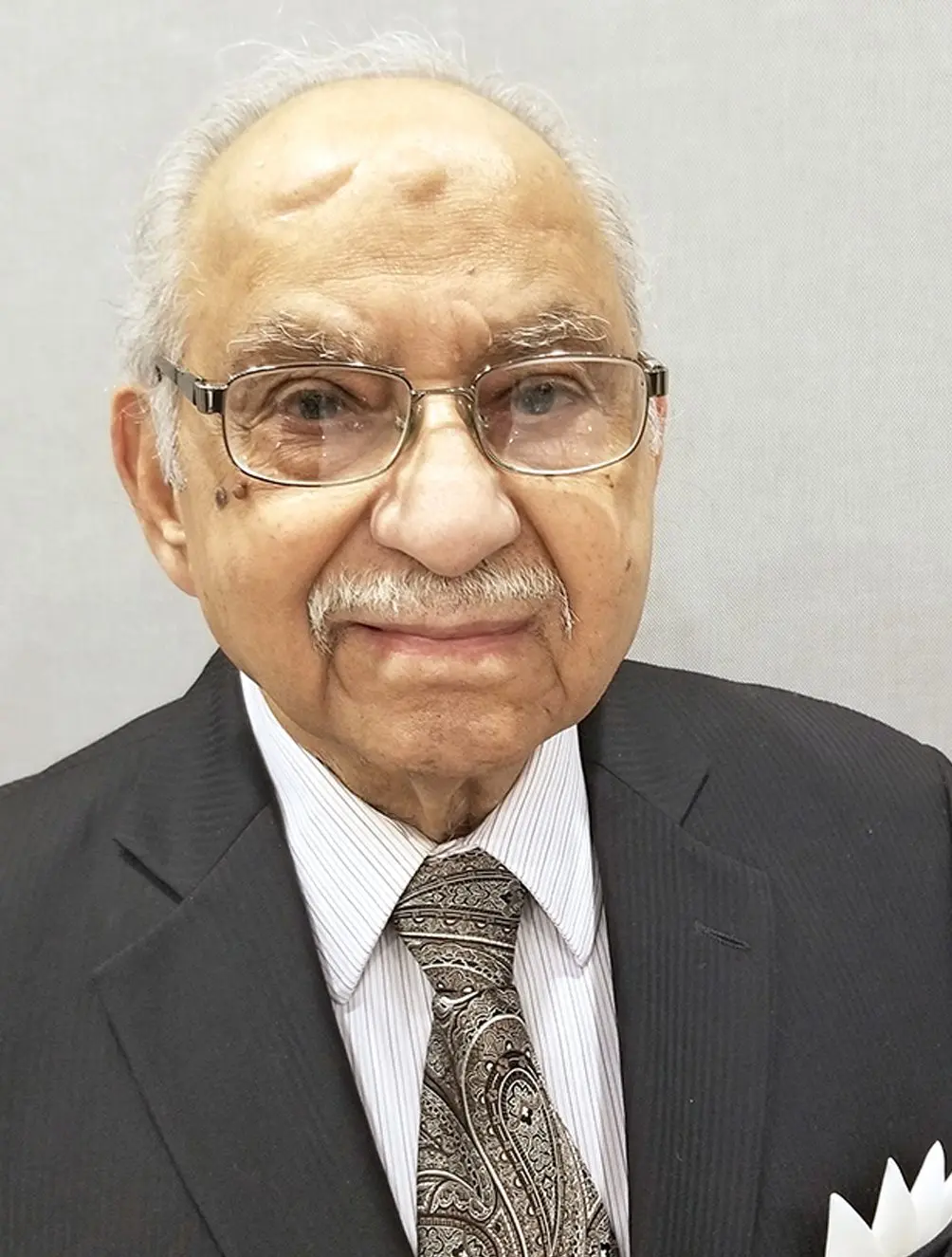
He has lived for his families, the family that he was born into, the family that he created and the family that he lives in – the society. In his 92nd year now, he probably has slowed down but his spirit is as high as ever. Likewise, an organisation that he founded has grown from a small team of 50 members to over 3000 today! All this while, he has continuously grown focused.
Many Gujaratis of that period would travel to distant lands, especially Africa, for better prospects for their families. Kalyanji’s father, Vallabhbhai Mistry, was also one such concerned-for-family man. He went to Ethiopia to build a future and had returned to India just before Kalyanji was born on 22 December 1930. To take care of him was his extremely loving mother, Manchaben. Vallabhbhai had gone back to Africa soon after Kalyanji was born and returned to India again in 1934. Later, they welcomed three daughters, Nandiben, Vajiyaben and Ruxmaniben. Vallabhbhai then returned to Africa and went to India four years later in 1940. Kalyanji was 10 then, growing up in the loving care of his maternal grandmother, uncles and aunts. He started considering them his actual family – when Vallabhbhai wanted him to return home, he denied. “I told him that he wasn’t my father. It broke his heart; he knew he had lost me. My maternal family consoled him and told him all would be well very soon. They managed to convince me and I returned to them eventually. Oh, I was still a kid and in love with them.”
The foundation
Back in Eru, he joined grade 4 and topped his class for which he is grateful to his youngest maternal uncle, Balubhai, who was just five years older and extremely caring and helped him study. He remembers that this was a period of raging independence struggle in India and intense sentiments against the British. Some school students boycotted the English language. When Kalyanji informed his father about this, Vallabhbhai explained to him that he would need the language in Africa. Kalyanji, thereupon, began learning it. He proudly remembers his role in the independence movement. He was in Madrasa High School when some people in the village came up with the idea of staging a play titled, Mukti na Panthe, themed on the freedom movement. The play continued till late night and was well-attended. As it began, his friends and he proudly hoisted the Indian tricolor. Soon the police came looking for the organisers. He was one of the main producers and had to go into hiding. The villagers too remained tight-lipped about it. As much as the police tried, they could never find them. The place where the Indian tricolour was hoisted has been made into a village square with a flagpole where the national flag is hoisted on every Independence Day. Even now, whenever Kalyanji is there in the village on 26 January, he is given the honour of hoisting the national flag there.
He started working in the field with his mother and managed to save some money, which he utilised in learning accountancy and typewriting at a private vocational training school, P.L. Patel’s Practical Training School. He completed it in late 1947 – the same year that he had passed Gujarati grade 7 board exams. This was also the year when his father returned from East Africa and suggested that he too should tag along.
Building his opportunities
Kalyanji initially resisted as he wanted to continue studies but his father suggested that he study in Uganda. When his maternal grandmother came to know about this, she suggested getting him married. Soon after, he got married to Laxmi on 29 February 1948. Two months later, he and his father sailed for Mombassa, Kenya.
He regards this journey as his turning point of sorts. “During the journey, I realised that I was married now and should be taking care of my wife, without my father’s support.” Kalyanji soon found a job in Saroti, Uganda, which required a lot of commuting. It was tough but he continued on it for about a year before he got a break in the East African Railways. It paid him better once he passed the qualifying exam. Thereafter, he was sent to the railway training school in Nairobi. Laxmiben eventually joined Kalyanji around 1953, and their first child, Sheila, was born in November 1957 in Mombasa, Kenya. He was then transferred to Kampala, Uganda, where they had two sons, Jitendra in 1959 and Jai Prakash in 1960.
He distinguished himself with his professionalism and work ethic under difficult circumstances in Kampala and won the appreciation of his employers. Kalyanji anticipated the East African turbulence could throw life out of gear especially for foreigners like him and decided to move to the UK in 1963, where he lived for four years. Two of their youngest children were born here, Tara in 1965 and Sanjay in 1967. When Sheila developed chronic bronchitis while in London, the couple decided to leave the country for good.
He had initially planned to return to India but his brother-in-law, Amratbhai, persuaded him to go to Canada instead. He, in fact, sent Kalyanji all the immigration documents and flight tickets too. The family finally landed in Canada in October 1967. He soon got a job as a billing clerk. His typing skills came in handy here but it was initially tough for him to adjust to the new IBM typewriter. He says, “The electric IBM typewriter... you pressed a key and it started moving. I was making a lot of mistakes on my first day there”. What also added to the difficulty was the three-hour long commute in public transport. He said, “I wasn’t spending time with my family; I would still have my job in the post-office in London if I were to return. I just wanted to go back to a peaceful life”. Amratbhai calmed him down again and assured him that this problem would be sorted out.
A few months later, he was able to buy a car but it wasn’t easy yet. The first 20 years in Canada was a struggle and he had to do part-time jobs to make ends meet. Thereafter, things fell in place as his children grew up and got settled. As Kalyanji had to abandon his education at an early age, he was very determined for his children to complete their education to their fullest – the children’s accomplishments say it all.
Sheila is married to Dalpat, a psychiatrist in Oshawa. They have three children: Niraj, married to Tanya; Seema, married to Rakesh; and Chetan.
Jitendra practices dentistry and has his own clinic, Mistry Dental Office, in Mississauga. He is married to Anita. Their daughter, Chetna, is married to Jayan. They have two sons, Suraj and Vikesh.
Jai Prakash is a mechanical engineer, with an MBA from University of Phoenix working as a brake specialist. He is married to Uma and lives in Michigan (USA) with their three children, Deepen is married to Jayna, Neil to Shelby and Maya.
Sanjay, a management accounting graduate from the University of Waterloo, postgraduated in business administration from the University of Phoenix. Sejal, his wife, and he have three children, Pritesh, Dhiral and Anisha.
Tara is a dental assistant and lives in California (USA), with her three sons, Krishan, Devan and Rajan.
For the larger family
In 1969, Kalyanji joined the Gujarati Cultural Society of Toronto and many other organisations, doing a lot of laudable work. Amid all the humdrum of the various organisations, he along with his brother-in-law, Prabhudas Prajapati, and 50 like-minded families founded the Shree Prajapati Mandal of Toronto (SPM) in 1974 from a basement. He was the elected president of the committee and continued in that role until 1987, and thereafter has been an active trustee even today. The SPM, with more than 3000 members now, aims to promote education and culture and provide work opportunities for youth.
He was also president of the Federation of Gujarati Associations (FOGA) of Toronto in 1987, but actively participated from 1977 to 1988. They organised the famous Indian spiritual leader, Morari Bapu’s Toronto visit in 1997.
Kalyanji always wanted to do something for his village. A sincere devotee of the village’s Rameshwar Mahadev Temple, he was deeply concerned that the temple was too small. Whenever he visited India, he would always offer prayers there. During a 1998 visit, he went to the temple and fell ill because of poor ventilation and restrictive size.
He decided to rebuild the temple and spoke to influential people of the village but nothing worked till 2017 when his close friend, Manubhai Lad, visited him in Canada. Manubhai agreed and helped to coordinate efforts for construction after the legal work. The temple was ready for inauguration in December 2019 but Tara’s husband, Paresh, suddenly passed away. Thereafter, it was inaugurated in February 2020. The happiness of the villagers is still fresh on Kalyanji’s mind and he is extremely grateful to God for enabling him to accomplish this task – one of his greatest achievements. Steely determination was one of the main things that has helped Kalyanji throughout his tumultuous life. He believes that working hard, being honest and having a strong determination to succeed will help you face any adversity in life.