
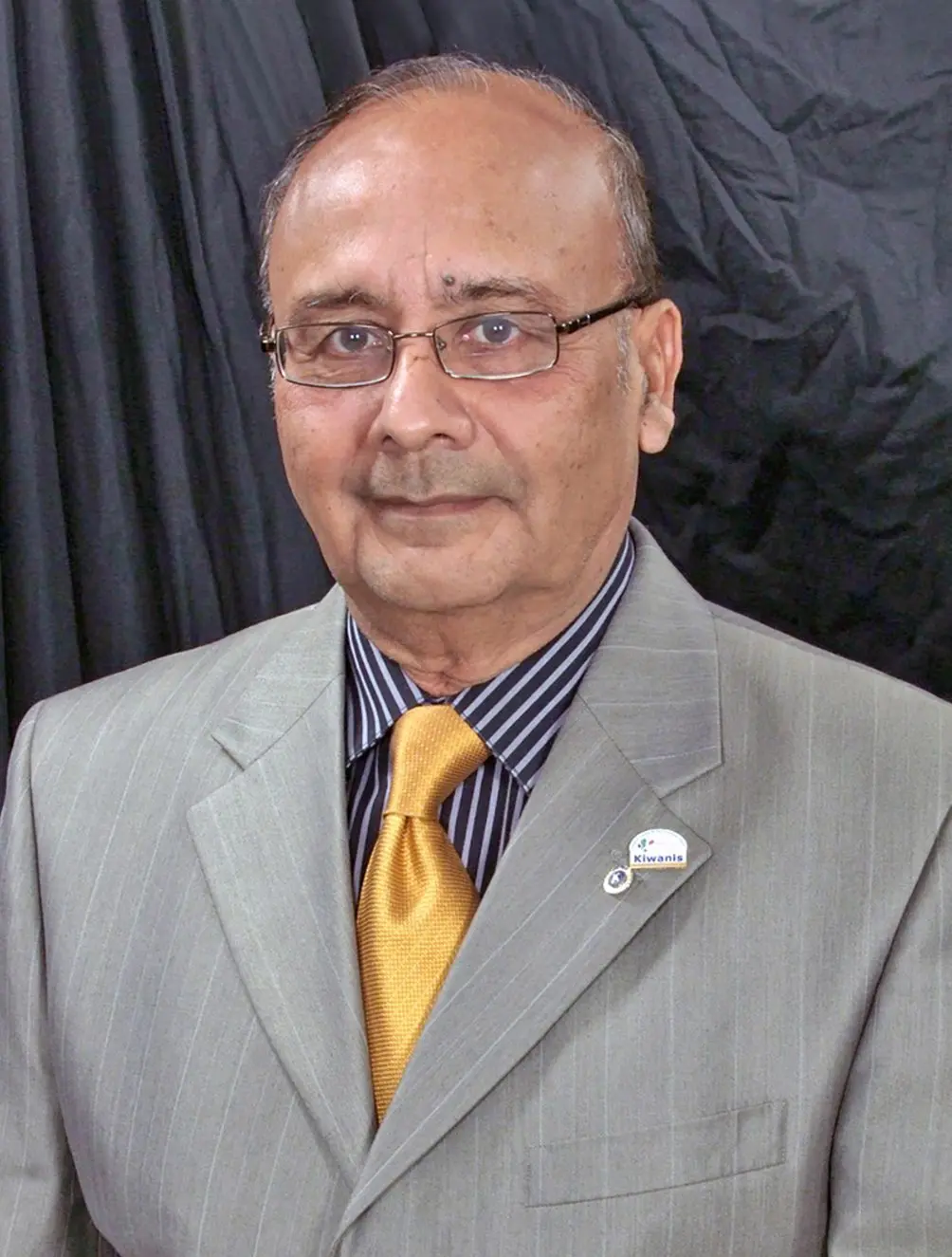
Uttra and Subhas have gradually transformed into a power couple, since their marriage in 1963. They are the first Indo-Canadian couple, honoured by the governor-general of Canada with the Meritorious Service Medal (MSM) for their concern and work for societal upliftment in brain and mind health
The couple has watched brain diseases first hand; they have experienced the devastation in their family – the reason they contribute and dedicate themselves to support research to find its cure. There are more than 500 brain and mind diseases, some of the most dreadful diseases in North America.
Subhas’ father, Dr. Roshan Lal, had Parkinson’s and mother, Dr. Sumitra, had Alzheimer’s in times when these ailments were not heard of; the diagnosis was even tougher. He still couldn’t forget the days when the world saw his parents’ fiery spirit on display.
Roshan had a very humble childhood, though he grew up into a very jovial and active person. Right after his postgraduation, he got married to Sumitra, MA, DT, the community’s first graduate woman. They made a perfect team – probably the inspiration behind Uttra and Subhas’ togetherness. Sumitra, an educator in a women’s college in Lucknow, supported Roshan to get through his apprenticeship without pay, in Lucknow. She was a freedom fighter. Subhas was a preschooler when she was jailed by the British twice but nothing stopped her to work for the nation.
It was only after India’s independence that in 1948, she gave it up and concentrated on Roshan’s career advancement. She left her job as the principal of a women’s college and concentrated on writing books ranging from textbooks to encyclopaedia for IAS aspirants. Sumitra and Roshan both left for Syracuse, New York to earn their Ph.D., in forest chemistry and education, respectively, because job prospects in India were bleak.
After Ph.D., Roshan immigrated to Cornwall, Canada, as a researcher in a paper mill in 1955. Sumitra left for India after her Ph.D. and came to Canada with Subhas and Rochana in 1956.
In the meanwhile, back in India, Subhas and Rochana were growing up to become abled citizens. “I’d changed as many as 11 schools between Lucknow and Nainital. I started my early schooling from none other than the college where my mother was a principal. So, among 4000 female students, I was the only boy and a toddler! Oh, and I still miss those rickshaw rides.” He adds, “When in Nainital, I definitely had a good time, but I couldn’t meet any of my family members for three years – those were the longest three years of my life. The only connection I had with my parents in the USA was through frequent letters.”
It was in 1956, when Subhas was 17 years old, when the entire family reunited in Canada. Subhas found it a bit challenging to settle in. While he was a Hindi-medium student in India, he suddenly had to move to English-medium at McGill University. “I barely passed my exams here, except for maths and physics. So, I was put to learn English along with other foreign students. After the first year, I passed every exam with flying colours so well that I was on the dean’s list.”
Upon graduation from McGill University, he joined Northern Electric, a part of Bell Canada. “I sent my first salary to my grandmother in Lucknow. We were very close. I grew up listening to her read the Ramayana.” shares Subhas. This was also the time when computers had started making their entry into the academic world and he was lucky to have learned it during his graduate in industrial engineering from the University of Michigan in 1963.
Back in India, Roshan was revolutionising the paper industry. He excelled in paper technology and had a team builder personality. He rehabilitated a large completely burnt down paper mill and added more capacity. Designed and built several paper mills based on tropical raw materials by recruiting engineers for the first time in the industry. He built over a dozen well-known paper mills including Century Papers in Nainital, Rayalaseema, ITC in Vijayawada, etc. Meanwhile, his initial contribution to Fibracan Inc. in Montreal was flourishing with plants in Japan, Saudi Arabia, Canada and the USA. He had accepted the most prestigious honorary position of the founder chair (1973–1976) of the Hindustan Paper Corporation, an Indian government’s undertaking. The business was also growing tremendously in India so he asked Subhas to join him.
The family union
The family had a happy reunion in 1973, but it took Subhas and Uttra a lot to wind up their personal affairs and their side businesses – import of Indian food distribution to North America from Montreal and New York. They had started Suro Services Ltd. to import and export food items, tools, etc., from India and East Africa. All this while, like an ideal Indian mother, she would never leave Suruchi, their daughter, under any caregivers’ care, but always carried her along, at the place of their business, often taking help from neighbours and friends.
Both Uttra and Subhas had full confidence and faith in his father. The young couple had four daughters, Suruchi, Charu, Urvashi and Anjali, when they shifted to India and welcomed their son, Siddharth, in India. Ideals ethics, knowledge and experience took them to success soon. Not only for work but they found their return to India quite helpful to Roshan and Sumitra but also in one another way – getting their children introduced to Indian culture.
However, it wasn’t meant for long. What followed was a test of endurance.
What doesn’t kill you makes you stronger
In the early 80s, Roshan started to keep unwell and couldn’t focus much on business. His health was jeopardised so terribly that Subhas almost immediately rushed to bring him and his mother to Canada in December 1984. He, however, could never recover after all the treatment, though nothing could be diagnosed. Within the same year, his mother too was diagnosed with Alzheimer’s. It was a difficult time for Uttra and Subhas – they could hardly focus on establishing their business. “Times were tough.” The kids were growing up and demanded attention. Parents demanded attention. Business demanded attention. We didn’t have enough time and energy for work, we didn’t have enough money to buy a house on a minimal down payment. We were praying for this to end...”
But it wasn’t to.
Suruchi had a head-on car accident – one that neck down paralysed the vivacious 22-year-old. Medical experts didn’t see a chance for her to walk again. She, however, like her parents and grandparents, wasn’t the one to give up easily. She went to Delhi (India) for treatment and began to take steps. Unfortunately, she breathed her last on 19 April 2005. “Yet we are happy that our children are all settled and doing better than us,” says Subhas. They have seven adorable grandchildren.
He had joined the Kiwanis Club, Ottawa, and became its first-ever president of colour. Uttra, not to be left behind, also joined and soon became president of Kiwanniane Club in Ottawa, doing distinguished volunteer work. She, alongside Subhas, also started day-care centres for children in 1983. Affected by a family tragedy, Uttra, with the help of Subhas, worked hard to raise awareness for young children and their needs. She started children’s community day in 1991. By its third year, they had 15,000 children and adults; media and government organisations and other businesses had joined her; by fourth year, the Canadian government had approved 20 November as the National Child Day in the Parliament after much advocacy.
Subhas today is the chair of the community advisory committee of Brain and Mind Research Institute. “We work for the causes close to our heart. I have seen my father working hard to give wings to his entrepreneurs; it took me to contribute to ‘I Create’ in India, it promotes independence among youth to learn entrepreneurship to start a business. Almost all our donations and efforts go to removing the root cause of the issue. That’s what I think is the real meaning of philanthropy.”