
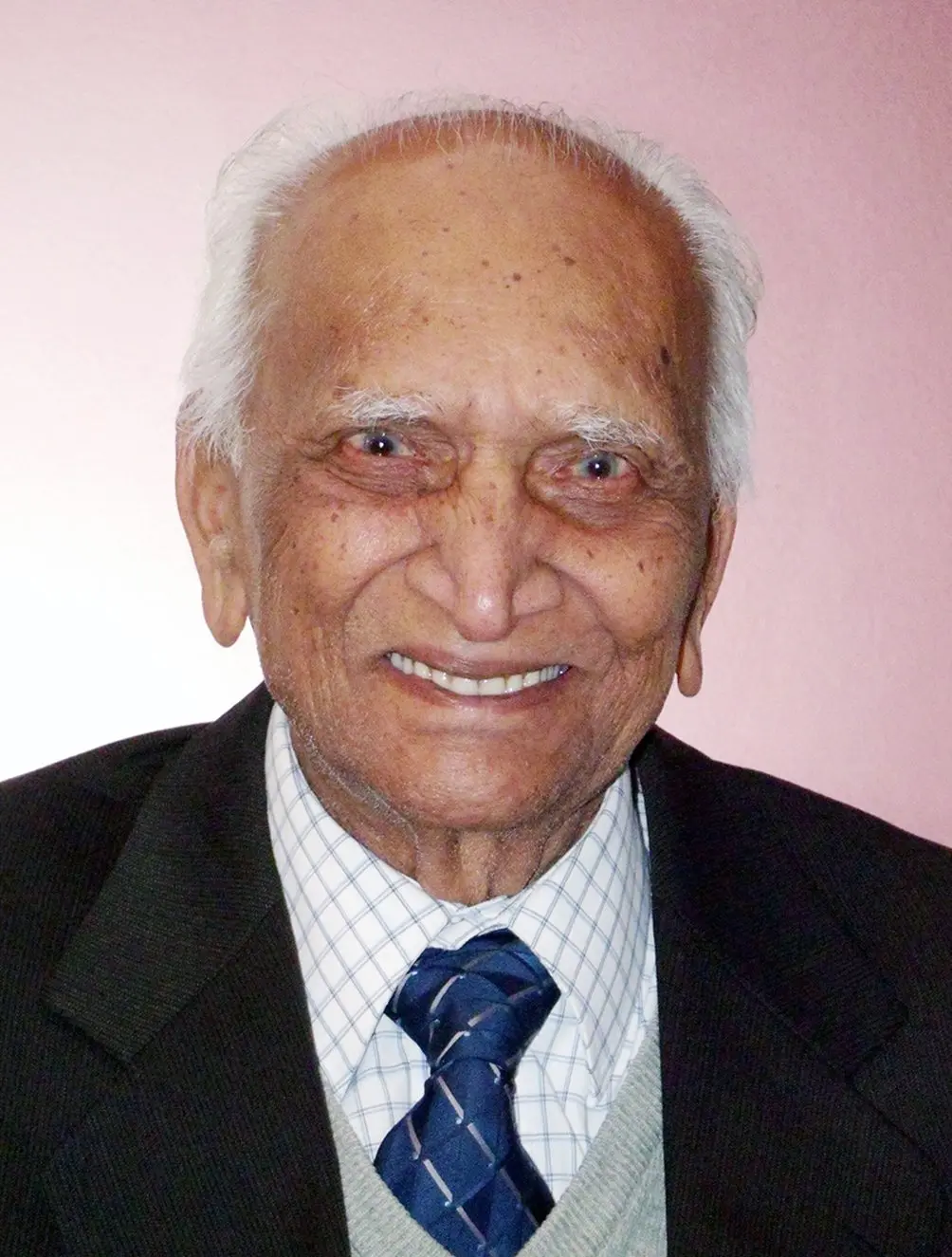
He was born when World War I had just ended. He grew up in India under both British colonial brutality and extreme poverty; and migrated to Kenya before India achieved independence and saw a similar movement there as well. Having lived in three countries: India, Kenya and Canada, he gained a wider perspective on life and experienced the joys of living in independent nations. After all this, at age 102, he smiles wide and galore, behind which is sheer hard work and years of uphill battles, often accompanied by misery. His is a story that makes readers’ eyes well-up.
Vinod was born in 1919, but his mother passed away when he was an infant and his paternal aunt took him to Indore in Madhya Pradesh to stay with her. Due to her deteriorating health, the boy was returned after a couple of years to Nar and then to Manej, where his maternal uncle and grandmother took care of him in a hard village life of poverty.
As he grew, Vinod was enrolled to attend Nar Primary School where he stayed with his paternal grandmother, Banji Ba. His father, Jethalal, worked as a manager in a paper factory in faraway Bombay. She showered lots of love and affection on Vinod, who was now a happy boy. Suddenly, one morning, Vinod at the age of 14, found her lifeless. The shock of the tragedy stayed with him for life. Jethalal came to attend his mother’s last rites; it was the first time the father was meeting his teenage son. Strange are the antics of life; it brought Vinod a dose of happiness during a tragedy! Jethalal, who lived in Bombay as a paying guest, took him along and enrolled him in Gokaldas Tejpal High School. About three years later, Jethalal had a nervous breakdown due to the pressure of work, bringing up his son and paying for lodging. He lost his job and they went back to Nar. At the age of 17, Vinod was once again feeling despondent upon being back to the village, with his father mentally unstable and no income.
It was tough for the two of them to sustain financially. Once again, Vinod went to live with his maternal uncle and now, a blind grandmother in Manej. They lived in abject poverty. Daily meals were hard to come by. Along with his studies, Vinod helped at home. He would walk to school 3km away, returning to tend to the animals and help with farming. Struggling to study during the nights, he passed grade 10 exams in 1939.His school principal understood his financial limitations and frequently paid his monthly fees. In the meantime, Jethalal’s condition worsened and he was sent to a mental asylum in Vadodara.
Vinod’s ambition was to be a university graduate. When he was accepted at Baroda College the bachelor of arts programme, he had no money for tuition. Miraculously when rummaging through some grain storage vats at home, he discovered his mother’s hidden gold jewellery. This paid for his tuition. In college, he joined student cadets and economised to survive with limited funds. In 1942, he was involved in the independence movement, going to villages to request council members to resign as a protest against British imperialism. When his group of students was waiting to board the train to Baroda, some soldiers opened fire without warning, killing four of them. The injured were pleading for help, but to no avail. Luckily, Vinod managed to escape but that brutality still haunts him.
Even before he graduated in 1943, he was married to Hansaben on 28 April of the same year. She was a rather humble and loving lady. Though uneducated, she supported Vinod and later, their children in every way possible. Right after graduation, Vinod was offered a job in Nar High School. His ambition to go overseas was still strong.
Great things take time
In 1946, a friend, Chagganbhai, brought him a job offer from Kisumu, Kenya, which he grabbed. Leaving behind Hansaben and their six-week-old son, Kirit, he sailed to Kenya. Going down the memory lane, he says, “On landing at Mombasa docks, I stood in the immigration line. As I approached the officer, I noticed that a fee of KSh. 200 was required. I only had KSh. 50 and in my pocket and felt agitated and helpless, tears rolling down my cheeks. A kind man behind me inquired about my nervousness. When I told him, he offered to pay my fees. Again, luck and providence were helping me”. In Kisumu, Vinod was appointed the principal of Gujarati Girls School. He stayed with Chagganbhai and his wife, Sushilaben.
Vinod worked hard and was able to get his family to join him in Kisumu in 1948. His work ethic and discipline earned him community respect and financial stability. He requested the school management to grant him a year’s sabbatical to further his education. They readily agreed and paid him half salary. So in 1952, he went with his small family to India, where Vinod earned a second degree: bachelor of teaching from the Baroda University, living in the T.K. Gajjar Hall of Residence. The family stayed in Nar. A year later, they returned to Kisumu and Vinod resumed his position with the school. In 1954, Hansaben gave birth to a daughter, Anjna.
In 1958, Vinod was offered a job with better prospects by the Kenyan government run Kisumu High School.
He moved up with successive promotions and, in 1962, was transferred to a higher position in Mombasa, where Kirit earned a higher school certificate. After completing aeronautical engineering from Manchester University, England, he started working for Rolls Royce Aero Engines in Derby. In 1971, he got married to Yogini, who was working in a car dealership company in Nairobi. They have two sons, Kunal and Chirag, who are married and live in Vancouver.
In 1976, Anjna married Jagdish in Mombasa. The couple, with their three girls, Kruti, Chintal and Sheena, now live in London, England.
Life is a full circle!
In 1973, Kirit and Yogini moved to Montreal to work for Pratt & Whitney Aero Engines, and then to Toronto in 1979. In the meantime, Vinod retired from his teaching profession and after a brief stay with Kirit, he and Hansa settled back in Nar in their ancestral home. Hansa, however, couldn’t live this peaceful life for long and succumbed to a heart attack in 1983. A year later, with urging from Kirit and Anjna, Vinod joined Kirit in Toronto.
Moving his base to a new country at the age of 65, he saw everybody working. Considering himself too young to retire, he went job hunting. But even with 30 years of experience and two educational degrees, the ministry of education refused to recognise his qualifications. So he tried his hand at multiple tasks: telephone marketing, security officer at Metroland Publishing, and his most successful one, as an accredited court interpreter and translator. He continued till he was in his late 80s. He volunteered to teach English to immigrants through Peel Literacy Guild. Moreover, he joined some voluntary organisations: Peel Multicultural Council, Police Liaison Committee, Friends of Central Library, Springfield Co-operative Committee, Older Adult Centre and the Credit Valley Hospital volunteers. Philanthropy was not new to him; he was a part of Patel Samaj in Mombasa too, where he was elected successively as a secretary, vice-president and then president in 1974.
While growing up, having received help from family, friends and even strangers, Vinod never forgot to offer a helping hand to others. His passion was education and he donated extensively to schools in Nar and Manej. In Canada, he has been a regular donor to the Mississauga and Oakville Hospitals, all the organisations where he volunteered, and recently to Sheridan College. Together with a couple of friends, in the 1990s, he was instrumental in establishing Gujarati Seniors Samaj of Mississauga (GSSM).
Following the footsteps of his father, Kirit was instrumental in setting up the Gujarati Samaj of Montreal in 1976. In Toronto, he took a leadership role at GSSM, being the secretary, vice-president and president during 2008 to 2018. He made significant contributions to the organisation, earning recognition throughout the Greater Toronto Area and extended a hand for unity to other community organisations.
When Vinod looks back at life, he feels it was all God’s will that he never gave up, and in return, he was looked after time and again. To repay this gift, he now helps and guides people. He feels blessed to see his great-granddaughters in Canada, Jiya and Ava, running around him whom he loves to pamper. He feels blessed that his children and grandchildren are well-educated and settled in their lives in England and Canada. A satisfying smile sweeps over his face as he says, “there’s more to life than just living – helping others”.