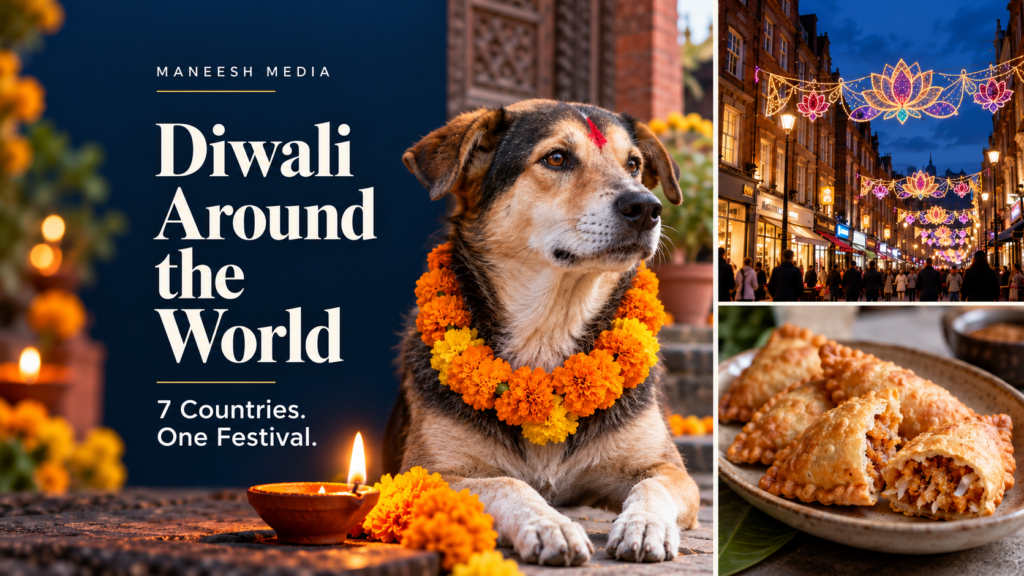
Seven countries. Four continents. One festival with a remarkable talent for making itself at home. A dog wearing marigolds in Nepal. A motorcade ablaze with lights in Guyana. Sweet-potato delicacies in Mauritius. And an entire British street celebrating an Indian festival.
Diwali has certainly gone places.
Carried across oceans by migrants, merchants and generations of families, the Festival of Lights has acquired local names, customs and flavours. Some are centuries old; others are surprisingly recent. Here are seven illuminating examples of how traditions travel—and transform.
1. Nepal: Every Dog Has Its Diwali
Locally called: Tihar or Yama Panchak
In Nepal, Diwali is not just for humans. During the five-day festival of Tihar, crows are honoured as messengers of Yama, the god of death, while dogs receive marigold garlands, tika and special meals in recognition of their loyalty and sacred associations. Cows and oxen also have their own rituals.
The Spark Moment: Among the Newars, the indigenous community of Kathmandu Valley, Tihar includes Mha Puja, or worship of the self. Family members sit before intricate mandalas in a ceremony of purification and renewal. It also coincides with the Newar New Year, observed according to the Nepal Sambat calendar, whose era began in 879 CE.
2. Malaysia: An Open House. Literally.
Locally called: Deepavali or Hari Deepavali
In Malaysia, festive hospitality extends beyond family and faith. The tradition of rumah terbuka, meaning open house, sees Hindu families welcoming friends, neighbours and colleagues from different communities. Colourful kolam designs decorate entrances, while festive food encourages conversations across cultures.
The Spark Moment: The open-house custom isn’t exclusive to Deepavali. It is also associated with Hari Raya Aidilfitri and Chinese New Year, making it a distinctive expression of Malaysian multiculturalism. Here, the Festival of Lights is also an invitation to come together.
3. Mauritius: A Sweet-Potato Surprise
Locally called: Divali
Forget the usual mithai for a moment. Mauritians celebrate with gato patate, delicious fried sweet-potato pastries filled with sweetened coconut. Families prepare sweets, illuminate their homes and share festive treats with neighbours. The tradition reflects how Indian culinary heritage adapted to the island’s ingredients and influences.
The Spark Moment: Large-scale Indian indentured migration to Mauritius began in 1834. Generations later, Divali is a national public holiday, while gato patate remains a distinctly Mauritian reminder that traditions can travel across oceans and acquire entirely new flavours.
4. Trinidad & Tobago: The Village That Diwali Built
Locally called: Divali
Imagine an entire village devoted to the Festival of Lights. At Chaguanas, Divali Nagar becomes a cultural centre featuring devotional programmes, Indian music and dance, traditional cuisine and exhibitions. It celebrates the heritage of Indo-Trinidadians, whose ancestors began arriving from India in 1845.
The Spark Moment: Established by the National Council of Indian Culture in 1986, Divali Nagar began in a shopping-centre car park before growing into a major annual institution. What started as a temporary cultural gathering became a lasting symbol of Indo-Caribbean identity.
5. Guyana: Diwali on Wheels
Locally called: Diwali or Deepavali
Why keep the lights stationary? In Guyana, elaborately decorated vehicles become travelling displays of illumination. The Diwali Motorcade features glowing floats, scenes from Hindu mythology and devotional music, drawing crowds along its route. The tradition reflects the country’s Indo-Guyanese heritage and brings celebrations beyond homes and temples.
The Spark Moment: Introduced by the Guyana Hindu Dharmic Sabha in 1974, the motorcade has become one of Guyana’s signature Diwali spectacles. Here, the festival doesn’t simply light up the neighbourhood. It drives right through it.
6. Suriname: Where Diwali Speaks Sarnami
Locally called: Divali
In Dutch-speaking Suriname, Divali remains an important celebration among the Hindustani community. Families light diyas, offer prayers and gather to share festive food. Alongside these traditions survives Sarnami Hindustani, a language shaped by the Bhojpuri and Awadhi-speaking ancestors of today’s community.
The Spark Moment: On 5 June 1873, the Lalla Rookh arrived carrying the first major group of Indian indentured labourers. More than 150 years later, Divali is a national public holiday. The festival has preserved not only religious traditions but also a connection to a remarkable linguistic inheritance.
7. United Kingdom: The Golden Mile That Glows
Locally called: Diwali
Every autumn, Leicester’s Belgrave Road, affectionately known as the Golden Mile, becomes a spectacular corridor of lights. Shops, restaurants and community spaces participate in celebrations that attract visitors from across Britain. The festival reflects the influence of South Asian communities, including families who migrated from East Africa.
The Spark Moment: Leicester’s first public Diwali street lights appeared in 1983. A neighbourhood initiative eventually became one of the city’s defining multicultural celebrations, showing how a migrant community’s traditions can become part of its adopted city’s identity.