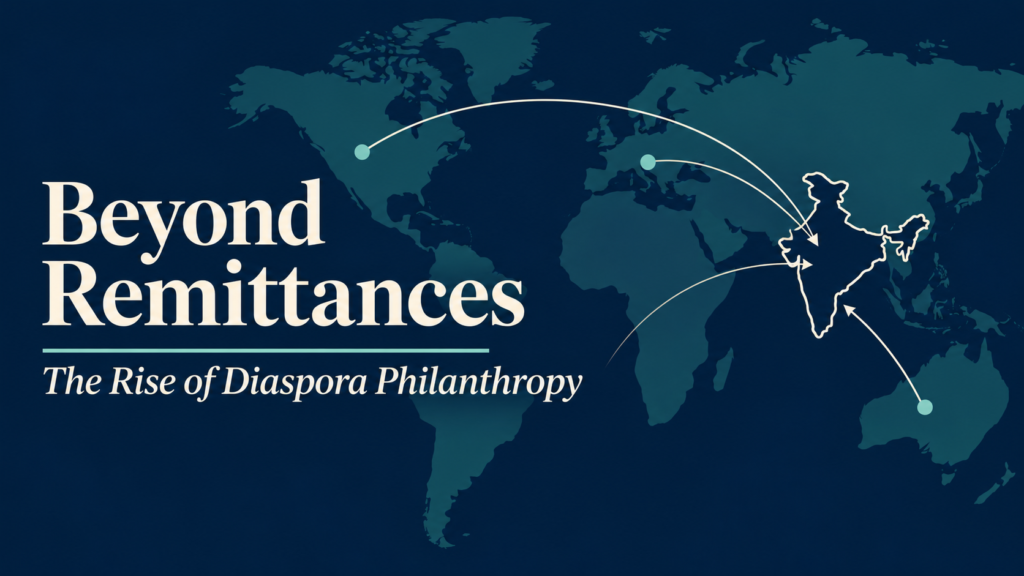
Whenever we talk of NRI contributions to the Indian economy, remittances always make up a considerable percentage of the pie.
Sending money home has been the most tangible expression of the NRI connection with the motherland. Be it supporting parents or funding education for family members, or donating amounts to help the village school, these acts have been long woven into the Indian psyche thanks to the spiritual upbringing.
The narrative has become stronger today with families emphasising the importance of responsible wealth, conscious leadership and intergenerational purpose. The question is no longer just about how you preserve it, it’s about how you give it meaning.
Giving Structure to Seva
What was once a personal act of giving is now veering towards more structured philanthropy, impact investing and long-term social change.
The scale of the opportunity is considerable. India’s diaspora expanded from 18 million people in 2019 to 35 million in 2024, according to the India Philanthropy Report 2025. Its economic influence is matched by its professional expertise, entrepreneurial experience and global networks.
The Story in Numbers
Consider the Indian-American community. Research by Dalberg, the India Philanthropy Alliance and Indiaspora estimates that its annual philanthropic giving rose from US1–2billion in 2018 to US4–5 billion in 2024 — a threefold increase. The estimated gap between what the community gives, and its potential giving has also narrowed, from US2–3 billion to approximately US1 billion.
These figures suggest more than an increase in generosity. They point to a shift in giving behaviour, with donations rising from an estimated 1–2% of household income in 2018 to 4–5% in 2024.
It is important, however, to distinguish philanthropy from remittances. India received a record US$135.46 billion in remittances in FY2024–25, but much of this money supports households and families rather than charitable causes. The challenge is to build on this established connection and create more avenues for purposeful giving.
Goodwill, but with measurable impact
Education and healthcare remain important priorities for diaspora donors. Yet the conversation is widening to include climate resilience, gender equality, livelihoods, financial inclusion and access to technology.
There is also a growing interest in how contributions are made. Beyond writing a cheque, diaspora philanthropists can offer professional expertise, mentorship, governance support and access to international networks. Impact investing provides another route, bringing together capital and the intention to generate measurable social or environmental outcomes.
The Roadblocks Persist
Good intentions do not automatically translate into effective giving. Donors may struggle to identify credible organisations, assess outcomes or navigate regulatory and compliance requirements across borders. Trust, transparency and accountability are therefore central to the future of diaspora philanthropy.
A recent study by the Centre for Asian Philanthropy and Society highlights precisely these challenges: interest in giving back is strong, but regulatory complexity and trust gaps can prevent formal philanthropic capital from reaching organisations on the ground.
Calling upon the Next Generation
The most significant opportunity lies with the next generation. For younger members of the diaspora, India may be a country of ancestry as much as personal experience. Philanthropy can become a meaningful way to engage with that inheritance — not simply by giving money, but by contributing to the future of communities and causes.
The question, then, is no longer just how much the diaspora sends home. It is how thoughtfully that capital, knowledge and influence can be put to work. Because giving back, at its most meaningful, is not an obligation to the past. It is an investment in the future.