
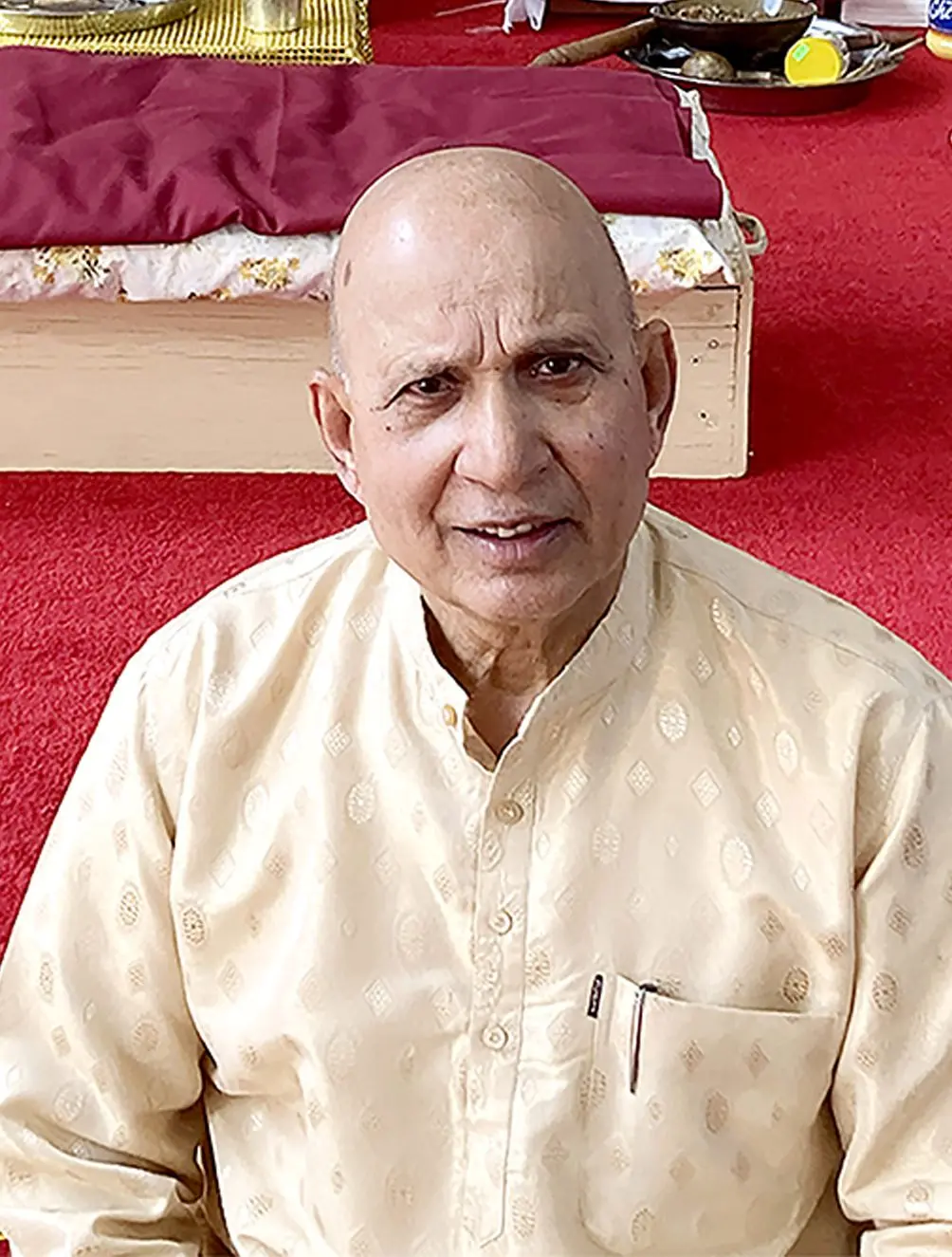
It’s not often that a simple village boy, the son of a farmer from a remote, nondescript village, Antroli, manages to touch the pinnacle of success all on his own. To start from Gujarat to Germany and finally reach Canada, where he now lives for the past 50 years, is no small achievement. In between, he has scaled phenomenal heights as a dairy technologist, businessman, entrepreneur, community builder and much more. Today after a long and giddy career and lifestyle, he has wound up the strands of his various enterprises and prefers to live in quiet post-retirement, far from the hustle-bustle din.
Chiman was born on 8 February 1944 in an agriculture-prime family. His mother, Gangaben, a housewife, and his father, Bhikhabhai, a farmer, along with all of their four children, Ravjibhai, Manekben, Savitaben and Chimanbhai, lived in a large joint family. The youngest in the entire extended family, Chiman found himself surrounded by companionship, playmates, filial love and security. There was also plenty of disciplining and mentoring, common in traditional Indian families, where all and sundry try to exercise their authority over the youngest.
And then, suddenly, Gangaben left the world; Chiman was just 13 at that time. “I don’t remember anything particularly wrong with her health; she was just frail and delicate. And as my father was the eldest among his siblings, she had to shoulder a bulk of household chores and every other responsibility,” says Chiman, thinking hard.
His eldest brother, Ravjibhai’s wife, Sonaben, took him under her wings and cared for him like her son. Chiman studied in the village primary school, Antroli Prathmikshala; for his studies till grade 5, he went to a nearby town, Kathlal, to live with a cousin, Manibhai. A strict task-master, Manibhai ensured his performance in school was top of the class. Chiman went back to Antroli to finish grades 8 to 10 from his old school. The following year, 1962, on Manibhai’s suggestion he sat for engineering at Sardar Patel University (Anand) entrance exam.
On their way back home, luck stepped in and changed the entire course of his life. On their bus ride back to Antroli, Manibhai ran into an old acquaintance, Dr. R.C. Patel. He happened to be on the faculty at the Dairy Technology Institute, Anand. He suggested it would be a good idea to attempt to take admission at the institute the next day. He was able to convince Chiman that dairy technology would be a far better career path since there were only two colleges giving this course in India, one in Anand (Gujarat) and the other in Karnal (Haryana). In between, he explored his adventurous side too with getting enrolled in NCC and mountaineering.
The flight to success
“Manibhai’s friend, Chimanbhai (yes, his name was Chiman too), in Germany, suggested that I explore dairy production in Germany. He helped me with visa and I flew to Germany in 1968,” says Patel. Working in Molkerei Dairy in Gudensberg, he found new horizons. To explore further, he decided to go to Canada in 1970. However, he found the country rather unwelcoming initially.
In spite of his professional experience of working in Baroda Dairy and Amul Dairy, Anand, as well as in two dairies in Germany in two and a half years, getting a job in Canada was not easy at all. Left with no options, he took up a cleaning job in a dairy plant in Toronto in 1971. “It was a night-shift job, where I was cleaning all the dairy equipment for a dollar and 50 cents an hour”, he recalls. “It doesn’t seem like much now, but at the time, it meant the world to me. It was a tough, gruelling job, requiring a lot of hard physical labour. I suppose the only reason why I got the job was because not many people wanted it”.
Hard work has its own rewards. In time, word of this young Indian’s diligence and sincerity got around. Soon, a job offer as a reliever in another dairy came up. Chimanbhai was soon handling four different jobs in the dairy industry and was promoted as production reliever and at Darigold/McCain Foods Production. Exploring different ventures, he along with three other partners opened an Indian grocery store. “I can’t say it was anybody’s fault. Chemistry between us partners was missing, so we had to eventually sell the business,” he says. He got into partnership in manufacturing card-board boxes but this was also sold in a short time. Then he collaborated with the circuit board industry as a full-time partner in a joint venture. After 13 very fulfilling years in the dairy industry in Canada, he decided to quit as the new business was doing well. The company started off with just five people and within three years, it had more than 100. Success made the partners branch out into crimp circuit board production, followed by a partnership with family and friends in metal fabrication, machine shop, plating, freeze pop, printing and plastic moulding companies. But in the end, only three of these ventures survived.
Today, Patel has freed himself of all his business commitments and leads a peaceful retired life. However, he finds his actual peace in an activity that endears him to many!
For the society, not just the community
In the beginning, Patel’s social work and philanthropy were limited to organising social events to mark Indian festivals or dance and music programmes, mainly involving members of the Gujarati community. Over the years, he got involved in Prarthna Samaj, Hare Krishna, Gayatri Parivar, Patidar Samaj, Swaminarayan Satsang Mandal, FOGA and Gujarat Samaj. “But we all realised, we needed to do something concrete. Many community members thought it would be a good idea to establish a temple, which would be a rallying point for all our functions, religious or otherwise.”
Finally in 1994, the groundbreaking ceremony for a Sanatan Mandir Cultural Centre was performed with community members, Chimanbhai and his nephew’s participation. Chimanbhai, as the building chairman, along with other members, arranged the temple’s site granted by the Ontario Municipal Board.
While helping create awareness about India in Canada, he has not forgotten his responsibilities and duties towards his people back in Antroli. He has set up the Bhikhabhai Bhulabhai Patel Charitable Trust in his father’s name which endows funds for needy students, donates books for the school library and builds new classrooms, undertakes projects to improve sanitation and drinking-water facilities in the village, etc. In everything he does, his nephews fully support him.
From childhood till eternity
For most Indians from the times that Chimanbhai comes from, choosing a spouse was never in their hands but it was a prerogative that rested with parents and elders. Chiman was barely 14, in grade 8, when he was married to Kamuben (7), a student of grade 1, in 1959. When he first flew out of India in 1968, he was unable to take her along. Kamuben was living with her parents in India at the time and finally joined him in 1971, in Toronto. She, with her giving and sacrificing nature, has always been Chiman’s biggest support. She has not only looked after all their kids, but also been their friend. She ensured making time for their extended family and also the society in Canada and India.
The couple welcomed their first son, Devenkumar, to the world in 1973. Today, he and his wife, Amee, are both qualified pharmacists. They have two children, Sahana (15) and Ronan (13). Their second son, Amit, has a seven-year-old son, Avik. The youngest, Bina, a doctor of pharmacy, and her husband, Fernando Silverio, live and work in Michigan.
Patel has seen life in his small village and across the world too, yet his family is completely Indian. Not only has the Patel couple inculcated all the Indian values in their family, but he often inspires his grandchildren with his favourite Bollywood songs like ‘Itni shakti hume dena daata’ and ‘Ae malik tere bande hum’, explaining them the meanings too. ‘Ye desh hai veer jawanon ka’, his go-to song, reminds him of India.