
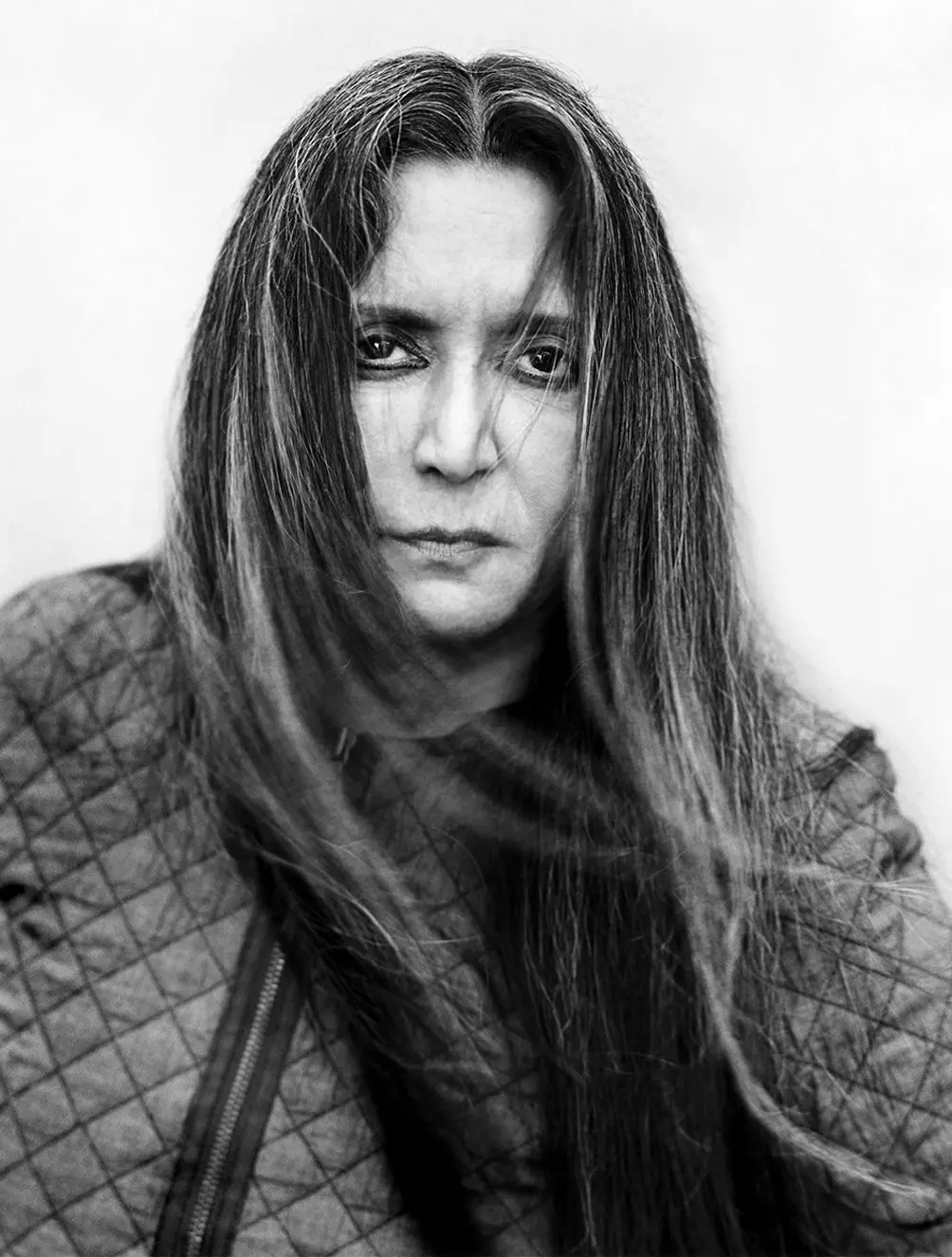
The inescapable influence of cinema and the lasting impact it has had on her was very much evident since her childhood. Since their father, S.K. Mehta, was a film distributor and the owner of Ashok Cinema Hall, Deepa and her brother, the award-winning photojournalist and filmmaker, Dilip, frequently dropped in at the cinema hall after school to watch movies and were also taken into the projection room. For her, watching films was a solitary experience. Watching Dr. Zhivago on an improvised screen at school is still fresh in her mind. Their father often told them, “There are two things one can never know about. One, when one will die. And two, how a film will do at the box office,” which probably is still the most important lesson the siblings learned about filmmaking.
Born on 15 September 1950, Deepa spent quite a substantial part of her childhood in Amritsar at her family home bustling with aunts and uncles. She recalls her student days at the well-known Welham Girls’ School, Dehradun, as some of the most informative years of her life. Later, she moved to New Delhi, where she later got her degree in philosophy.
By her own admission, Deepa talks about herself being an average student, but Indian philosophy intrigued her, especially Shankaracharya’s Advaita Vedanta. “But I hated all forms of physical activity. During our physical education class, I used to hide under a desk in the chemistry lab and read books.” Her best memories at school were of Mr. Rick, who visited the school every Sunday to screen a movie. He always chose her as his assistant as she knew how to set up a projector.
Talking about the major influences, especially the ones that shaped her thinking and her personality, Deepa speaks about her mother, Vimla Mehta. “She is one of the most amazing women I know... strong, powerful, uncompromising yet extremely loving”. One quote that she remembers from her is “Don’t take yourself too seriously.” Her mother introduced her to Munshi Premchand and her father exposed her to Urdu poetry. Deepa says that storytelling is about opening doors of perception. Mehta is a bibliophile and has sat on the jury of many international literature award shows.
Deepa has a deep understanding of the emotions writers express in their books. This resonates in her adaptations of Salman Rushdie’s Midnight’s Children and Shyam Selvadurai’s Funny Boy. Funny Boy has won awards for the Best Adapted Screenplay, Best Original Score and Best Director at the 2021 Canadian Screen Awards, and for Best Motion Picture and Best Supporting Performance Female at the 2021 Leo Awards. She had great fun finishing an episode of Showtime’s Yellowjackets. She is also the co-showrunner and director for Watford & Essex’s upcoming returnable series, Championess.
The artist behind her art
Apart from this, she says Satyajit Ray, an Indian film director, scriptwriter, documentary filmmaker, author, essayist, lyricist, magazine editor, illustrator and music composer, has always been her cinematic inspiration. “He is the greatest humanitarian filmmaker ever.”
Her father had a different view of films. “At home, my father always spoke of directors first and actors second, which was bizarre as nobody I knew paid much attention to filmmakers. Stars, music directors, cinemascope, etc. were counted, but directors? Barely a word! My father introduced me to the work of a great filmmaker, Satyajit Ray. This was huge and formative and my sense of his work has never left me.”
After graduation, Deepa worked at the Tea Board of India on Bond Street in London. Though her six-month stint was hugely boring, it taught her a lot about financial independence. She started to educate herself by reading. Looking back on those times, she says, “Reading made me think. Bertolt Brecht wrote that thinking, a major by-product of reading, is one of the most enjoyable activities”.
Deepa, after seeing the ups and downs of the industry through her father’s lens, “wanted to do nothing with films” when she was in university. Who knew from handling a school projector, she’d reach an Oscar nomination! On her return from London, she worked at Cinematic Workshop, a small company in Delhi that made advertising films and short films for the Government of India, where she learned how to do location sound, camera work and editing, which led to the making of her first short film.
Winning with elements of the cosmos
She moved to Canada in 1973 and kept her association with films strong. In her 30-year strong career, she has consistently broken new ground, tackled issues like intolerance, cultural discrimination and domestic violence. Yet, when she began, she began with no formal training. Her initial work included directing documentaries and script-writing for children’s films, like Spread Your Wings. Then Sam & Me happened, her directorial debut feature film in 1991 which won an honourable mention at Cannes that year.
In the world of films, her Elements Trilogy (Fire – 1996, Earth – 1998, Water – 2005) won global acclaim. The first feature film which she wrote and directed, Fire, won the Most Popular Canadian Film at Vancouver International Film Festival. Earth was India’s official entry for the Academy Award for Best Foreign Language Film. It premiered as a special presentation at the 1998 Toronto International Film Festival and won the Prix Premiere du Public at the Festival du Film Asiatique de Deauville and the Critics’ Award at the Verona Schermi d’Amore International Film Festival. Water became Canada’s official entry for the Academy Award for Best Foreign Language Film and was also her first nomination at the Oscars.
Fire was Deepa’s first screenplay. Recalling the trials of those days of inexperience, Deepa reminisces, “The amazing story editor Barbara O’Kelly said it was easy, ‘Three acts. Act 1, set-up your story and characters; Act 2, it all falls apart; Act 3, it all comes together. And oh yes, throw in a couple of ‘hero’ scenes. You know the big dramatic kind’. Armed with these words of wisdom, I wrote the script and knocked on all doors to try and find financing but came up with a big fat zero. And then my partner, David Hamilton, seeing my desperation stepped in. He was a businessman who loved movies. He was the person who first encouraged me to write a script. And now he was offering to help get it financed and to produce it.” They were thrilled when after a few international sales they could pay their team. “Years later, I found out that one of the first investors in the film was actually David”. When she speaks of David, she feels immensely grateful for his incredible patience, as her partner and the producer of most of her films, and says he’s always been one of her strongest support systems.
Later, in 1996, they together founded Hamilton-Mehta Productions. Deepa is very proud of her daughter, Devyani Saltzman, who has forged her own path away from film. An acclaimed writer, curator, arts leader, cultural critic and journalist, she has written Shooting Water: A Memoir of Second Chances, Family, and Filmmaking and articles for many international magazines and newspapers. The Manager, the pilot episode of Little America for Apple TV, is one of Deepa’s recent works. Another one is Leila, where she is the co-director with two others, is on Netflix. She’s also the Creative EP for this.
Deepa’s work challenges traditions and stereotypes and is always daring and provocative, which is clearly saturated in her film, Anatomy of Violence. The way she accepts challenges has brought her many other awards. She was awarded a Genie Award in 2003 for the screenplay of Bollywood/Hollywood. She has been named the Best Canadian Director (2006) by the Vancouver Film Critics Circle; the Best Canadian Director of 2006; and the YWCA Woman of Distinction (2008). In 2012, Deepa’s Midnight’s Children was screened at film festivals globally and was chosen as the Best Feature Film of 2013 at the Directors Guild of Canada Awards. The same year, she received the Governor General’s Performing Arts Award for Lifetime Artistic Achievement, Canada’s highest honour in the performing arts. In 2013, she was inducted as an Officer to the Order of Canada and also received the Order of Ontario the same year.
She prefers to be known as a storyteller of variety. She thinks it’s slightly naive to think that films don’t make a difference, as what happens films has a give-and-take relationship with society. She quotes Toni Morrison, “All art is political.” She believes that being an artist, it is up to her “... in times of war, conflict or peace ... to hopefully start a dialogue, not to be intimidated by fear and never to be silent ... The oppressive will be so firmly in place that we will no longer be able to voice our objections freely and we will be silenced for a very long time, potentially lifetimes.” All her work has been based on some or the social cause, with some of them substantially talking about women and immigrant issues. Gradually, she also came to be known as a gender rights activist and joined forces for women’s empowerment and took charge as an honorary international patron at an NGO, Sambhali Trust, which caters to women in Rajasthan and their growth and development.
“We shall overcome,” the anthem of the Trust, is also the transnational filmmaker Deepa Mehta’s go-to song!