
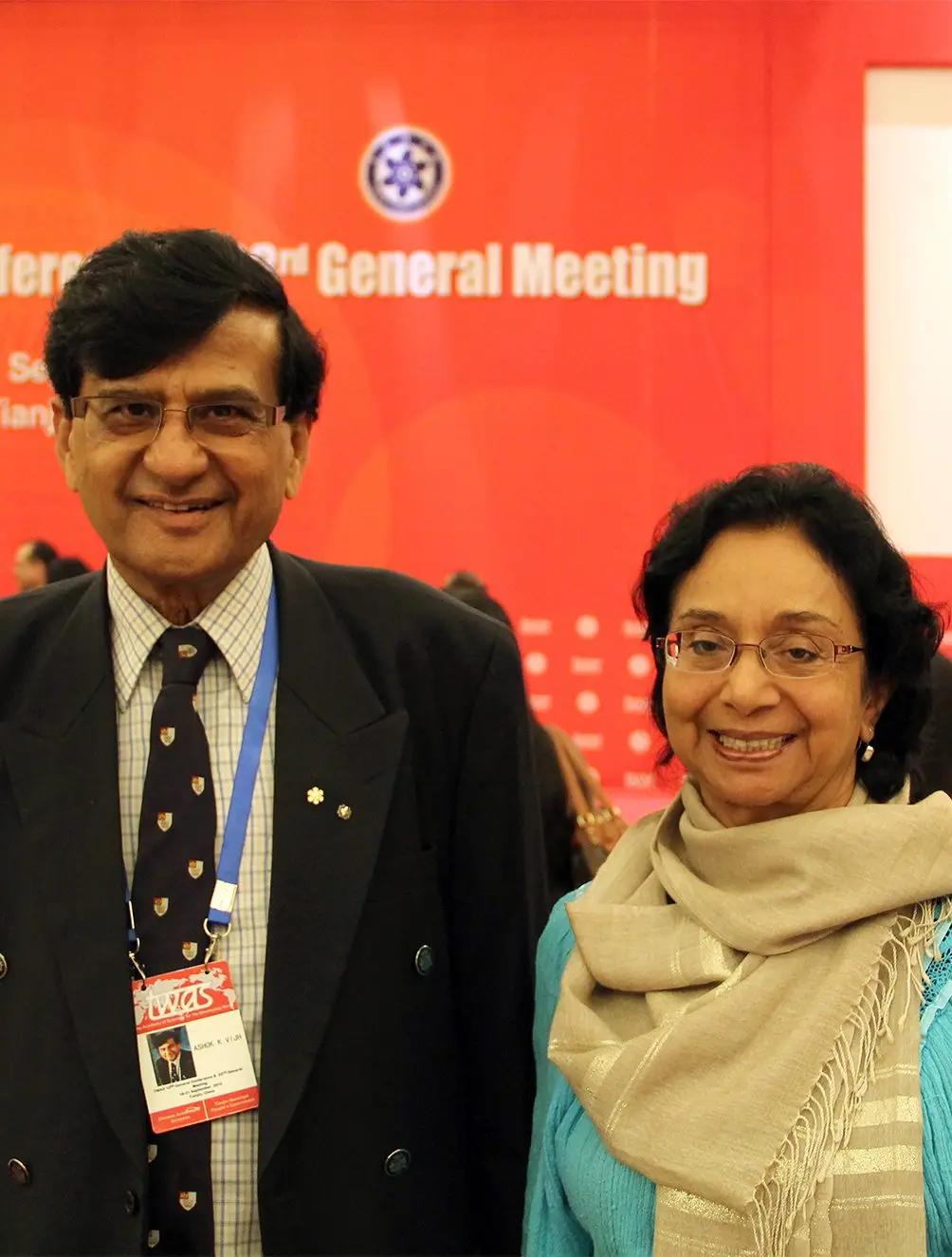
To introduce her, Dr. Ratna Ghosh has been called a differentiator by Time magazine. A multi-culturist, she promotes the right to be different and acceptance of different cultures, religions, languages and lifestyles. A Ph.D. in comparative and international education from University of Calgary, she has held many academic and leadership positions in Canada and abroad at institutions, organisations and boards and committees. Her research has focused on international and multicultural education, feminist pedagogy, development studies, culture and values and more recently on education and security. She was the first woman dean at the faculty of education at McGill University. She has won many awards and honours including the Order of Canada, Order of Quebec. She is a Fellow of Canada’s National Academy, the Royal Society of Canada, the World Academy of Sciences – for the advancement of science in the developing world. A regularly published author, her last two books are Redefining Multicultural Education and Education and the Politics of Difference. She is past president and honorary fellow of the Comparative and International Education Society (CIES) of the USA.
To introduce him, Dr. Ashok Vijh, Ph.D. in physical chemistry, is well-known for his research in electrochemistry. He has been termed as the father of electrochemical physics. He has received over 60 major honours, medals and prizes, published 8 books and over 400 refereed publications. His area of research and development is seminal work on electrochemical physics, electrochemical treatment of cancer tumours and electrochemical energy conversion and storage. He is a Fellow at the Hydro-Québec Research Institute (IREQ) and an invited professor at the National Institute of Scientific Research of the University of Quebec. He has also been the chair of a NATO Panel on chemistry, physics and biology. He was the first person of non-European origin to occupy this position in a G-8 country. He was president of the Academy of Science of the Royal Society of Canada (2005–2007) and has received several honorary doctorates both from Canada and India.
But they are both a lot more than just that. They prove yet another proverb right, unity in diversity, an ideal reflection of India: Ashok is a dynamic Punjabi, Ratna is a scholarly Bengali. Ashok didn’t like to study but preferred debating, student unions, political demonstrations, etc. But he doesn’t deny being a curious child. “I was probably 3–4 years of age and I loved the idea of school. I once got so stubborn I started going to school. It was on a street named after my grandfather, Chaudhary Chiman Lal Bahl. My father, Bishamber Nath, took me there and told the authorities to let me sit in the class.”
Ratna’s mother, Indira, ensured she topped classes, trained in singing and musical instruments like piano and dancing by guru Atambha Singh, learned driving, horse riding and yet was an ideal version of an Indian well-bred girl. She, in fact, later completed her diploma in pianoforte, performance and theory, from the Trinity College of Music, London. Ashok was always sure of his prospects and interests. When his father wanted him to appear for civil services examinations, he chose to complete his graduation and postgraduation in science from Panjab University (Chandigarh). “One of my professors, Dr. M.L. Lakhanpal, advised me to apply for Ph.D. under Dr. Brian Conway, who was his professor in the late 50s, at University of Ottawa,” remembers Vijh. He flew away to gain experience in one of the best countries, Canada, in February 1962.
Ratna attended school in Shillong and college in Kolkata. Her father, Gauri Shankar Guha, an eminent ophthalmologist, supported her in pursuing further education. Although she wanted to study maths for graduation, her mother, who had graduated in philosophy in 1934, would not let her attend any co-educational institution. The college she was allowed to go to did not offer maths and she ultimately studied English (honours) at Loreto College. For postgraduation, she went to Calgary University. “It was 1969. I then wanted to pursue law, but ended up studying comparative and international education for postgraduation with the idea of training as a teacher. I also applied for a government scholarship and ultimately won several awards on my journey to a Ph.D. degree!” Used to the warmth of her family, she didn’t like the cold of this country.
Ratna’s was a travel-loving family, often travelling abroad. It filled her with a lot of aspirations, but at the same time, her mother would feed her and her sister, Swapna, with the teachings of Sri Ramakrishna Paramhansa, Vivekananda, etc. To contradict which was her father, a tolerant agnostic.
When fate intercedes
Everything at Ratna’s front kept her tied to her roots; however, it was probably fate that wanted her to fly... high and off to Canada, closer to an unknowing Ashok. The late Dr. Hitschfeld, the then vice-principal of McGill University, introduced them. They met on 12 June 1986 when Ratna was a professor at McGill; Ashok was a scientist at the Hydro-Quebec Institute of Research and prominent in The Royal Society of Canada. They started seeing each other a year later and the rest is history! They got married to each other on 18 November 1988.
Their children, Partho and Aldous, are MBAs from top universities of different countries. Partho, based in the USA, is in finance and risk-management. Aldous serves Phillips (Canada) as the marketing manager.
What also brought the two together was their love and concern for India and travel there every year – more often than not as visiting professors at various universities.
Their interaction with the youth there brought them closer to their homeland. As the past president of Shastri Indo-Canadian Institute, she served as the resident director in its Delhi office when she took a year’s sabbatical. Ashok, at the same time, connects with leading Indian scientists, like Dr. C.N.R. Rao, Dr. Ajay Sood and other successive presidents of Indian National Science Academy (INSA) since 1994 when he was elected a Foreign Fellow there.
They have become the bridge of scientific development in both these countries. Believing that a better future lies in the youth, the couple choose to connect with them through education and research.
Vijh is, however, quick to add, “I remember my parents, though not given to religious rituals and superstitions, were very compassionate, humanistic and ethical. My parents ensured that all of us siblings – eight brothers and two sisters – grew up to idealise social justice and compassion and were not infected by any prejudices. Ratna’s mother was spiritual and father was more interested in helping people through his profession than earning money and believed in science. He was known to provide free treatment to the needy, which made many throng to his nursing home. The idea has always been to be an ethical person”.
And to quench their ever-increasing thirst for knowledge, they read a lot. Ashok shares, “We write too. We have written articles bridging electrochemistry and multiculturalism. And I still carry my interest in music – shayari, ghazals, poetry, etc. At times, we revisit India via Dilip Kumar’s (Indian superstar) Devdas or Deedar kind of movies. We find the music of K.L. Saigal, K.C. Dey, S.D. Burman, etc., evergreen”. Ratna laughs, “Ashok has recently developed a skill in cooking. And that suits me just fine”.
Still kids at heart, the couple takes their time off to travel, and why not! Isn’t it their childhood trait! They often are in India and have visited almost every state. “We have been to our schools, colleges, the places we grew up in. We miss the ambience and the people there. All of this is strange though, as we visit India almost every year!” A special highlight of Ashok’s visit to India was in 1999 when Panjab University conferred an honorary doctor of science on him along with I.S. Gujral and Mulk Raj Anand. Especially memorable events for Ratna were when she was designated to sign a memorandum on behalf of Canada on Indian national TV and when the then prime minister, Rajiv Gandhi, laid the foundation of the new Shastri Indo-Canadian Institute building.