
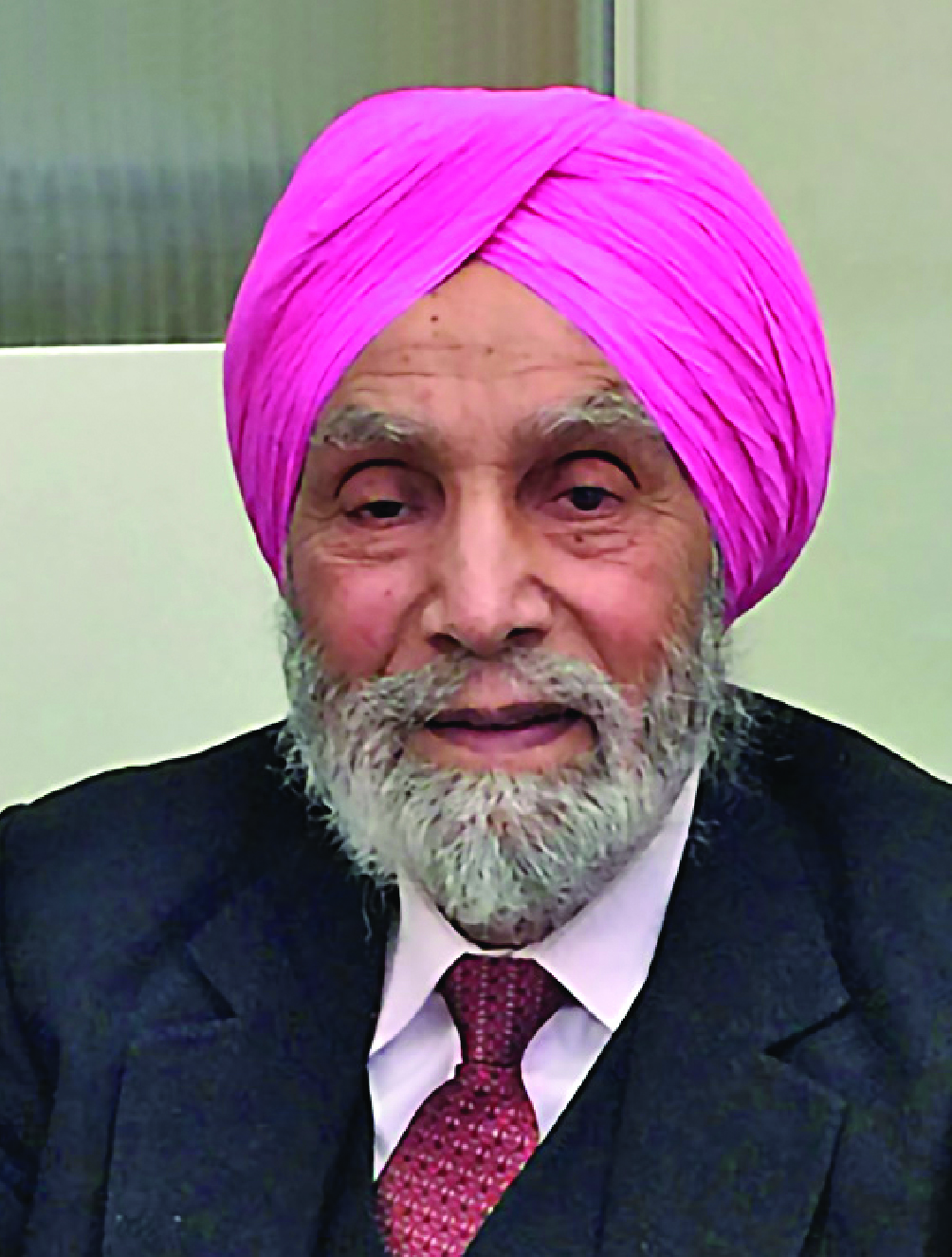
He served in the World Bank for 26 years. Was it easy for a turbaned Sikh and a man of color?
He tells of building his own cultural nest in the US when there were virtually no Indians. In an enthusiastic tone, he reminisces about his journey to the then ‘land of dreams’.
A product of Partition, he was born in 1928 in Sialkot (undivided British India). Life, he says, was simple then, there were few worries. “We enjoyed the harvest of our farms. Life in the village was beautiful. It was a typical Punjabi village inhabited by Christians, Hindus, Muslims and Sikhs. Virtually, every profession was a part of the cultural blend.”
His grandfather owned a farm, did carpentry and single handedly provided for a large family. His father saw action in World War I and on return started a brick kiln business. He did well in this and other ventures until the tragedy of Partition split their world. Like many hundreds of thousands, they lost everything and began a new life as refugees from scratch.
Shamsher attended his village primary school, moving to Church of Scotland Mission High School later. “I had nine siblings and my father prioritized our education. He had decided that if any of us did well in school, he’d send them abroad to study.” Shamsher was the middle child among his six brothers and three sisters. After school he continued his studies at the Sikh National College, Lahore, obtaining a bachelor’s in mathematics in 1947.
The Searing Trauma of Partition
The pain of what he endured in the spring of 1947 remains, the single most important event that split Hindu/Sikh and Muslim relations forever – Partition. In Lahore, his college friends (of all faiths) were agitating for independence and ironically wanted the British to lose WWII. A sad turning point came with the Muslim League vying to create a Muslim state; many across India’s political spectrum were opposed. As part of this agenda, Muslim League engineered what is known as ‘The Rape of Rawalpindi’. “The attacks in Rawalpindi were cold blooded and premeditated, aimed at silencing a revolt against the creation of Pakistan. Akali Leader Master Tara Singh protested as did Mahatma Gandhi and others; but the British, as was happening elsewhere in their fading empire, secretly drew the lines of partition and Lahore was handed to a sectarian force. We were arrested from college. I was jailed and tortured along with several college mates, many of whom went on to become prominent Indian and Punjabi politicians’’. No doubt a path he would have followed had he not emigrated. He remains in touch with one or two friends still remaining in Pakistan. Infact, he visited his village there in 2008 to release his book on village history and life.
Two things that gave him courage and hope to survive this horrific period of his life:
1) “Be still, sad heart! And cease repining; Behind the clouds the sun is still shining.”* 2) Charhdi Kala ** It was a tough life in the refugee camps of Daska (Pakistan): there was little food and *By Henry Wadsworth Longfellow in the poem ‘The Rainy Day’ (Ballads and Other Poems) **Kala means energy and Chardi, in Punjabi, means rising or soaring. It means an intensely energized, ever-ascending state of the spirit of an individual or of a group.
water, people bathed when it rained. His faith in the Gurus helped him. From Daska via Pasrur, the family eventually settled in Delhi. There Shamsher completed his Masters in Mathematics in 1950 from Punjab University, which two had partially relocated. One of his cousins was a Punjab Sessions Judge and had visited England. “He wrote an essay outlining how if one is willing to work hard, one can study and simultaneously finance oneself in the West. And that was it! To fulfill my father’s desire and to start a new life, with my family’s help I moved to England in 1953 – without plan, no admission to any college, nor employment. I first stayed at a London gurudwara.” He thought if someone can do it, then so could he.
In his two years in the UK, he worked at the Indian High Commission and obtained a Diploma in Statistics from Regent Street Polytechnic. The stint at the High Commission was informative; teaching him the basics of working in an office. “Aiming for a PhD I had secured admission to the London School of Economics, however I wanted to work and study, and I discovered I could more realistically do this in the US”.
The Long Road to America
Year 1955 saw a move to the US. “Washington DC, at that time, was not as dynamic as Delhi; it was quieter and less cosmopolitan. Life was, however, of a much better standard than in India or the UK. On arrival, he secured a job at the Indian Embassy and then worked four years at the International Cotton Advisory Committee, paying my way through graduate school. Tuition fees was astronomical compared to the UK. The US was refreshing but culturally, there was little I could identify with. I had to create a sense of home. There were few Indians, no Indian grocery stores or places of worship.
Eventually I earned my PhD in Economics from the American University in 1962.”
That year, three important things happened: He started a job at the World Bank, bought a house, and got married.
He was selected by the World Bank partly because professors had given high reviews of his thesis. Interestingly, when he appeared for the interview, World Bank officials were shocked to see a “dreaded bearded man”. The culture of the Bank of that era frowned upon beards. Still keen to hire him, a committee was appointed and concluded his beard was religious. So he joined the Bank and served 26 years, including as Visiting Fellow, University of Oxford 1976–1977 and as seconded Policy Advisor, Ministry of Finance, Ghana 1984–1987. In 1977 he personally delivered a letter to No 10 Downing Street demanding the return of the Kohinoor diamond to India, the last in Maharaja Ranjit Singh’s possession.
He represented the World Bank at numerous international fora including the International Energy Agency, the New International Economic Order proceedings and testified before the UK House of Lords and German Reichstag.
“I was born in 28, and I was 28 when I met my wife!” Welsh by birth, Margaret Peters met Shamsher in Washington DC, where she had recently emigrated. “She went to India ahead of our marriage and took Amrit at Bangla Sahib and adopted Sikhism. She (Margaret/ Maldeep) is a better Sikh than I am!”
The couple were blessed with five sons, Lakhdeep, Prithipal, Iqpal, Ranjit, Harjodh; and eight grandchildren, Damien, Milan, Dylan, Kieran, Ronan, Sahil, Liam, Roshni. “We enjoy our time with our precious grandkids.”
Grandpa of Indian Community
Shamsher has been instrumental in building the capital’s thriving Indian community and his extended family. He started out modestly, organizing Sikh celebrations as well as cultural and musical events. These started at the homes of embassy officials and his own house, being the first Sikh to buy a house in DC. As Washington’s Indian community grew and his social circle expanded – he became friends with Dalip Singh Saund, the first Indo-American Member of the US House of Representatives and was also an acquaintance of Shyamala Gopalan, the mother of the then young Vice President to be, Kamala Harris. He remained lifelong friends with his Punjab University classmate, Yogi Bhajan, leader of the American Sikhs, who also resided part time in DC.
Once while strolling along Massachusetts Ave in DC, a thought struck him: The Islamic Center of DC was established with the support of Arab Kings and Governments (Saudi Arabia, Jordan, Turkey, Egypt etc). Guru Gobind Singh ji said all Sikhs are kings! “I then wondered, if I am a king, why shouldn’t I build a gurudwara in the city! This thought became a passion.”
The National Gurudwara was opened in 2005 on land he purchased in 1981 along the famed Embassy Row. The genesis of this gurdwara was The Sikh Cultural Society he founded in 1964.
The city he sees around him today is very different, umpteen Indian businesses, prominent Indo-American citizens, and multiple gurdwaras. The National Gurdwara sits in the heart of the city and includes a plaque bearing his name and those of early sevadars/supporters.