
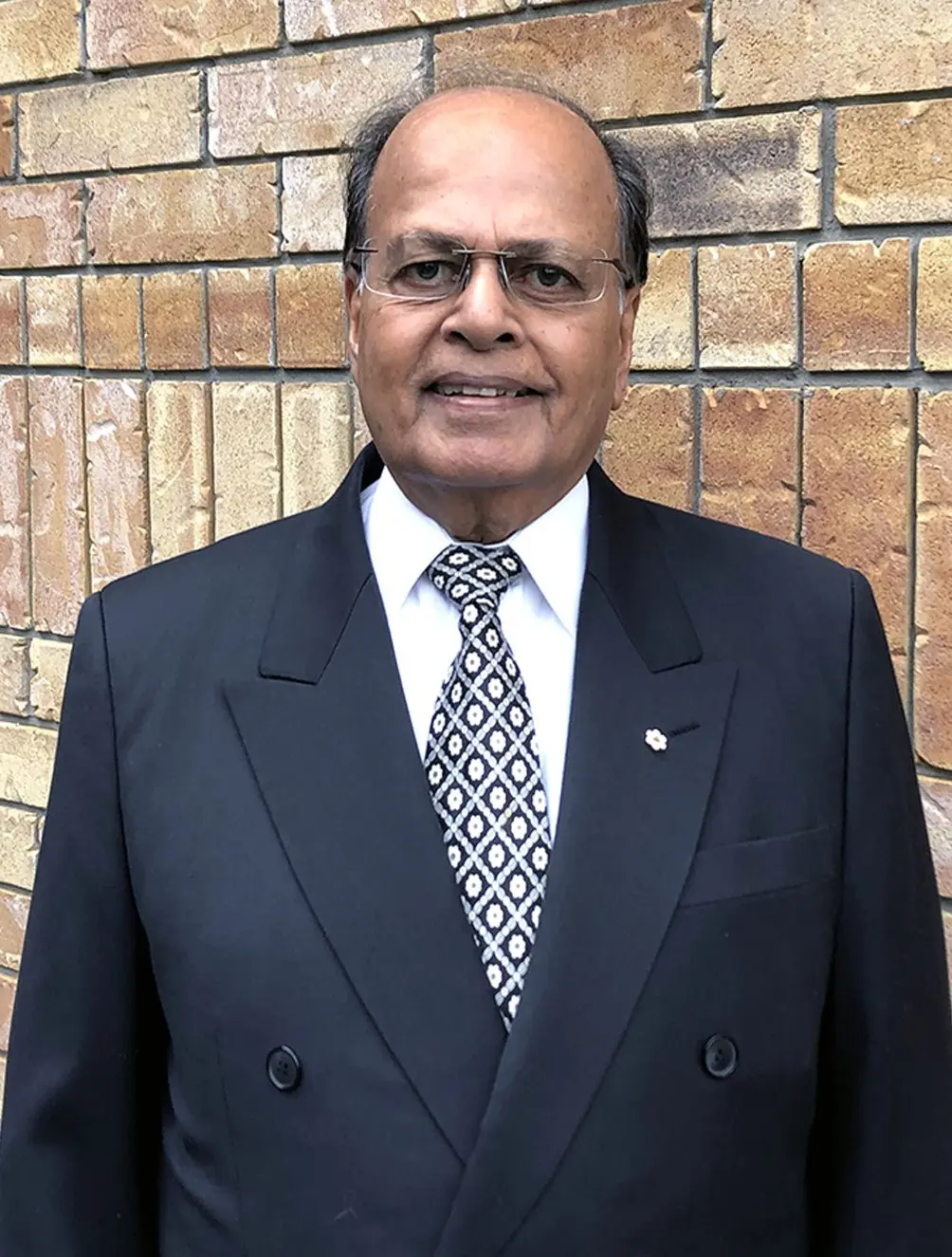
A simple man, Shrawan started his journey from Allahabad and finally settled in Canada – the country where he marked milestones after 40 years of age. He soared to heights by pioneering in interdisciplinary rehabilitation ergonomics. And it wasn’t a piece of cake.
Born in Allahabad to Mrs. Dhairyawati Devi and Mr. Tribeni Shankar on 1 July 1939, he grew up under an immense religious influence; but his mind was filled with numerous questions. As an only child, he was quite pampered and protected – he wasn’t even allowed to learn swimming for the fear of drowning. To understand his mother’s religious perspective, he read the writings of monks and gurus, including Swami Vivekanand, Swami Ram Krishna Paramhans and Swami Ramtirth at a very tender age. He also dove into Mahabharata and Geeta, two of Hindu scriptures. Yet, inner peace was escaping. Eventually, meditation brought him the contentment he craved. He practiced philosophical Hinduism that brought him in contact with several saints. This included Art of Living initiated by Sri Sri Ravishankar, an Indian spiritual leader. Today, a science academician, he is an ardent follower of Vedanta philosophy. He calmly shares, “We are a fragment of God, we only have to realise ourselves. We are immortal – the body is only the clothing that the soul wears.”
Shrawan completed his schooling from one of the most prestigious schools of Allahabad, Government Intermediate College. He completed his graduation and postgraduation in biological sciences from the University of Allahabad. Always one of the finest students, he won many opportunities from prestigious organisations and institutions, like the opportunity to postgraduate from the University of Michigan. He, however, had to let go of it as his family did not want to be distanced from him. “I eventually had started feeling dejected as I started to believe there was no opportunity for me. But life shook me; my mother expired during my masters, which is still the biggest loss of my life. My father was aging and I had to start earning for us and so I joined the CMP Degree College of the University of Allahabad as a lecturer.”
New ventures, new journeys, new success!
His destiny changed when one of his close friends, Dr. Prem Nath Srivastava, was immigrating to the U.K. Prem suggested that he too apply for immigration. He laughs and adds, “I was so motivated by the idea that I didn’t think twice and applied right away. Within a month I got my immigration. I kept quiet about it but my father came to know of it eventually. He too felt for me and one day, he told me that he would no longer hold me back. I was absolutely floored”.
His father wanted him to get married before he left for the UK. Prem’s in-laws liked Shrawan a lot and took their younger daughter’s proposal to Mr. Tribeni Shankar. Back then, most of the Indian youth had no choice but to agree to parental preference. Rita and Shrawan got married on 7 July 1965. She has a double masters degree in economics and has a bachelor of education too. Going down the memory lane, he recalls, “She stood by me through every thick and thin. In Toronto, she taught from elementary grades to high school. In Alberta, she taught in elementary school. She encouraged me to follow my passion. I always tried to not miss our dinners together. It hurts me that she too suffers from the same disease which took my mother away. Mom had congestive cardiac failure due to rheumatic heart. But now, I know much more about the treatment and ensure that there is no medical mismanagement with her.”
As soon as the couple landed in the UK, Shrawan started applying for various Ph.D. programmes and faced a mini twist of fate: he reached in July; admissions were closed by April. Hence, he had a spare year and to fetch for the two of them; he joined as the head of the biology department at the Queen Elizabeth Grammar School. “I used this time to apply to various universities for Ph.D. programme. And I was accepted at all of them, like the University of Oxford, London School of Hygiene and Tropical Medicine, Brunel University, etc.; however, each of them had their own terms and conditions. It was the University of Surrey (University of London back then) that offered me a postgraduate scholarship without any conditions for a Ph.D. programme in human biology in July 1967. I took the offer.” He never had any professional guidance, his decisions were based on his immediate needs. He graduated with a doctorate degree in January 1971. Immediately after graduation, he had job offers in London that he did not take.
However, the Trinity College, Dublin, gave him a postdoctoral fellowship in January 1971 in the faculty of engineering. With the additional opportunity of educational advancement, he decided to accept the offer for three years but decided to return to India in two years. “My ultimate goal was to go back to India and serve my country and stay with my father.” With his father he always had a profound bond of affection.
He returned to India as a pool officer at All India Institute of Medical Sciences (AIIMS), New Delhi. But soon, he realised that he wasn’t satisfied. While he was gyrating in possibilities, he was offered readership at the Punjabi University, Patiala, and was also selected by the Union Public Services Commission (UPSC) for the position of Assistant Director of Central Labor Institute, Mumbai, with five advance increments and received immigration to Canada within a few days. The dilemma of selecting the appropriate offer was overwhelming. He took what appealed to him the most – he took the position of Assistant Director of Central Labour Institute offered by the UPSC. India was still a developing country back then; a lot of hierarchical issues had to be taken care of and Shrawan didn’t find it as progressive. “I had organised a seminar series and at the very first event I received the director’s last minute cancellation. I found it absolutely frustrating.” It made him resign and decide to immigrate to Canada. He states, “We – Rita, Rajesh and I – arrived in Canada in July 1974. Was it the right decision? Could I have been more useful to India? I had a lot of questions romping my head.”
Within six weeks of arriving in Canada, he joined the Department of Physical Medicine Rehabilitation, University of Toronto. In 1977, he got an offer from the University of Alberta; due to his unique research. He didn’t shy away from hard work for a couple of years when he was teaching clinicians, a job he was inexperienced for.
What happened next... he stayed there for 30 years. Students enjoyed his teaching; his institute grew with him; he grew with them; all along enjoying his job and family time. By this time, Shrawan saw his father immigrate to Canada. However, Mr. Tribeni Shankar felt disillusioned seeing him working long hours and wanted all of them to live a relaxed and peaceful life. It broke Shrawan’s heart to see him leave three years later, but he knew he would find peace in India only. “I was first named Kundan. But later, I became Shrawan. Shrawan Kumar was known for his filial piety towards his parents in Ramayana. I wonder if I can hold a candle to the name.”
While at University of Alberta, he started receiving international recognition and accolades and was invited to different countries on all five continents. He bagged many international awards for his work excellence and fellowship of the National Academy of Science of India. He received fellowship of the Royal Society of Canada and was invested into Order of Canada in 2010 for the brilliant work on the causation, prevention and treatment of musculo-skeletal injuries.
After 30 years in Canada, he moved to the University of North Texas, USA, as a tenured professor and associate director of Physical Medicine Institute. Later, he served as the director before returning to Canada (Mississauga).
The couple takes pride in their children, Rajesh (1968) and Sheela (1977). Dr. Rajesh is professor of medicine at Northwestern University, Chicago, and married to Dr. Zoe Arvanitakis, a neurology professor at Rush University, Chicago. Their daughter, Penelope, is 10. Sheela (MA in philosophy from Ivy League school) works as a data analyst in Mississauga.
He has been an active member of the community and organised many events to raise funds for cancer research in India as the president of the Indo-Canadian Society and the Council of India Societies of Edmonton. He also helped raise funds to establish a girls’ school in Dullipur (Bihar) in 1989. It was started by his colleague, Dr. S.P. Singh.
He is a traveller and sports-lover and today, at the age of 83, he ensures finding time for reading, fitness, golf, table-tennis and badminton. His refusal to be put down distinguishes him. He came back up again and again and found a way around. He took chances and changed his direction several times. No matter how and what, he has made his own destiny.