
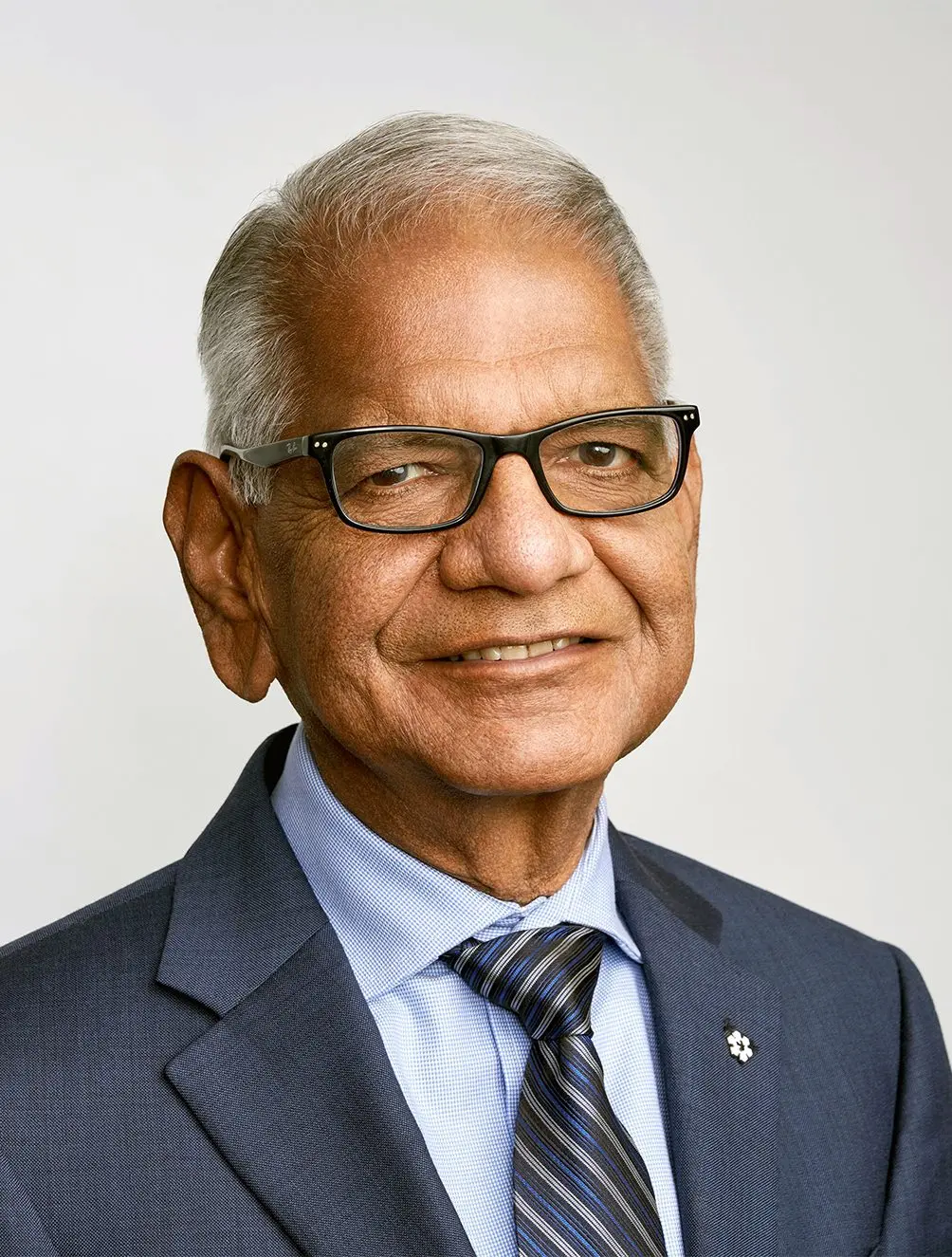
For Dr. Virendra K. Jha, trained as an engineer at IIT Delhi, employed as a management trainee with Delhi Cloth Mills (DCM) in 1968 moving to practically steering Canada’s nascent space programme to a position as a global player, in his 42-year association with Canada’s space program, his life has been an awe-inspiring and fulfilling journey.
Born on 21 November 1946 to Kunti Devi and Puran Chand, Virendra lived a happy, secure and comfortable life with his four siblings – Kamalendra, Mahendra, Pramila and Gyanendra in Ajmer. Puran had a permanent job in the railways and Kunti was a simple housewife.
But Dr. Jha’s narrative gains much more relevance if one were to step back one generation to the times of his grandfather, the late Har Prasad Jha. He worked in the railways, but the gentleman had a keen head for business and dabbled in real estate. Along with business, he also had a knack for language. A spiritual person, who understood the Vedas in all its true meaning, he had tried preserving Maithili language by publishing a monthly magazine. He had three children, two sons and a daughter; Puran Chand was the second. Their ancestors had meandered from Bihar to Agra before settling down in Ajmer. When the British were engaged in laying railway lines across India, Har Prasad Jha, quickly found a well-paying job. Together with his real-estate business, he was soon able to reach a position of affluence.
While Virendra’s grandfather did exceptionally well at work and for society, his father didn’t succeed as much. Har Prasad generally supported the needy children. One such child whom he had generously supported grew up to do well and became Puran’s boss at work and behaved badly with him. Har Prasad felt terribly hurt at his behaviour; after all, “how could you shout at the family of the person who has helped you stand on your own!” It left a mark on the young Virendra’s impressionable mind. Ever since, he knew he would grow up to be the ‘boss’ of whatever field he will be in!
The plus side of crying
When Virendra cleared his higher secondary with the second position in the state of Rajasthan, he was just 13, almost three years too soon. So how did he get there before his time is a question that automatically pops up. He was a cry-baby when he was in grade 1, a loser’s trait but not in his case.
As Jha puts it in his own words, “They called me Veeru, I remember! I used to cry and holler in my grade 1; I wanted to sit with my older brother, who was in grade 3. Only for the sake of peace and quiet, the school authorities allowed me to, thinking I would get over my tantrums but that didn’t really happen. Eventually they relented, I didn’t. And that’s how we became classmates... right up to higher secondary level. The higher level of studies wasn’t too much of a problem. I was able to cope well. Standing first in grade 6 was an added impetus. After that I could never settle for second place, it always had to be first”.
“I was equally interested in sports and games right uptil university. I have represented my college and university in hockey; later on I played for IIT-Delhi too. As I was underage, I decided to finish my B.Sc. from Rajasthan University first before joining IIT-Delhi and graduated in mechanical engineering with flying colours. The year was 1968 and I was just 22. I felt that the world was my oyster, and I could do anything I wanted to. I, in fact, wanted to be the prime minister of India (laughs); true, dreams go any which way.”
Virendra’s next immediate preference was to search for jobs. He found an opening with the DCM and was posted to Hyderabad as a management trainee. Although the training was to last two years, the group’s founder, Lala Charat Ram, impressed with Jha, decided to appoint him as a manager just three months later. However, Virendra was disenchanted soon and quit his job and took admission in McMaster University, Canada, for a master’s programme in mechanical engineering in 1969, which he was able to successfully complete in one-and-a-half years. “My grandfather, I remember, was the happiest person at that time. Not many people went abroad for studies back then.”
From Bihar to space
Jha recalls his first year in Canada as one of exciting challenges. “Campus students wore blue jeans and denim shirts, kept long hair and moved around bare-footed, silently but firmly protesting against the Vietnam war with their message of peace. Advised to dress rather formally, I seemed to stick out like a sore thumb. It didn’t take much prompting to blend in. Soon, I was a part of this surging mass of blue”.
“In early 1972, I had to abandon my doctoral studies in engineering after six months and take up a job at the behest of my research guide. I wrote a computer programme on his behalf for a company, RCA, he had a contract with them.
When Virendra explained the programme at the RCA no one could make head or tail out of it. Instead they offered me a job, which he continued for the next 20 years. While working he managed to complete his doctorate. The company undertook contracts on space engineering projects. In time RCA became Spar Aerospace, an associate unit of De Havilland. Throughout this entire process, he gradually moved from the position of junior engineer to the director of engineering. He had the privilege to substantially contribute to Canada’s high-profile space programme. Following the formation of the Canadian Space Agency (CSA) in 1989, he joined the organisation in 1991 as a director and rose to the position of acting president in 2006, before retiring from the CSA in 2015.
To keep himself busy, he still is a board member of Atomic Energy of Canada Limited and Pyro Genesis Canada Inc.
In all his 43 years of work, his leadership and contribution to the profession is reflected by various awards he has received. In 2018, he was recognised with the Order of Canada – the highest civilian honour in the country; John H. Chapman Award of the Canadian Space Agency; Life Time Outstanding Achievement Award by Indo-Canada Chamber of Commerce in 2016; Allan D. Emil Memorial Award by the International Astronautical Federation for 2015; Queen’s Jubilee Medal in 2002; Alouette Award in 1999 by Canadian Aeronautics and Space Institute (CASI).
His source of energy!
Dr. Jha and Ranjana, a postgraduate in psychology, who now works as a psychotherapist in Montreal, got married in India on 14 November 1975. It was all a very traditional set-up arranged by their parents. In Canada, she started as a dance teacher. They have two children, a son, Muneesh, and daughter, Shalini. Both graduated from McGill University and finished medical studies from Ireland. Thereon, Muneesh completed his residency from Winnipeg and now works in a Toronto hospital. He and his wife, Hallie Taylor, have two children, Jayan (8) and Maya (6).
After her studies, Shalini did her residency in the USA and specialised from London, Ontario. She and her husband, Rikesh Sood, have three sons, Reevin (6), Saamik (4) and Elan (1). Though born and brought up in Canada, she took interest in Bharatnatyam rather early in age and today is a proficient dancer.
Virendra, in a strange mix of likings, follows philosophy from Geeta. He regularly lectures Indian kids on lessons from Indian holy scriptures and spends his leisure time either playing golf with friends or with his family. This award-winning space expert also likes to write poetry and has in fact published a book, Anubhooti, a collection of his poetry. Ranjana is a keen theatre enthusiast, and has done both Hindi and English plays. Helping people holds the majority of her interest. She has served as the president of the Hindi Association of Québec.