
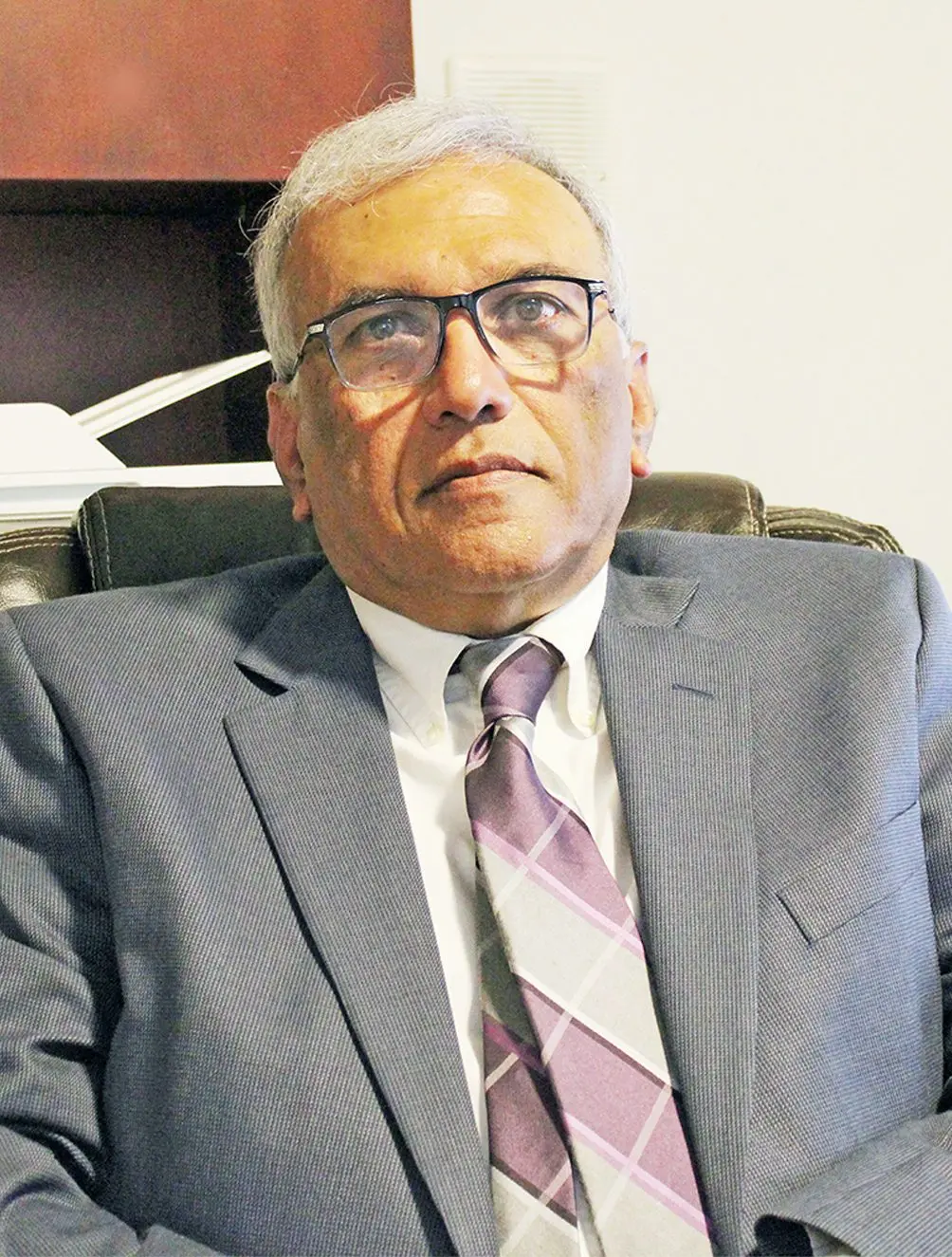
For over 34 years, Norwich Plastics has been an industry leader in plastic reprocessing. Established in 1987, sustaining and giving new life to plastics without compromising over quality, price or service, it gradually was able to find itself completely distinctive from competitors. Today, Norwich Plastics is known throughout the plastics and recycling industry in North America as a quality-driven company.
And why not! Dwarka Persaud has been recycling human thoughts and vibes with his knowledge of Hinduism, Geeta, Ramayana and other holy scriptures, even though he has never lived in India.
“The journey up until here has been long,” he says, “not tiring though.” What started from a small village, Gonda (Balrampur, Uttar Pradesh), was a rather unknown journey... which continued to Calcutta (now Kolkata) in West Bengal to Guyana before heading to Canada. It was Dwarka’s great-grandfather, Surjoo Prasad Mishra, who first left for British Guyana from Calcutta in 1874. Almost 137 years later, the family still takes care of its Indian and Hindu roots and values. Coming from a family of Hindu priests, working as a labourer was a challenge to Mishra in Guyana, but he didn’t let his spirit die and worked hard day in and day out to ensure that he provided for his family. His son, Ramprasad Mishra, proficient in Hindi, Urdu, English and Sanskrit, was initially a supervisor in the estates but as soon as he could afford it, he decided to do what his family tradition was and became a pandit. However, it was Ram Prasad’s son, Ganesh Persaud, who became successful in the worldly sense. After trying his hands at tailoring and selling clothing, he eventually added grocery, electronics and lumber and invested in other ventures. His wife, Boodhia, worked equally with him and being extremely religious and cultured, she had inculcated Hindu values in their 12 children as well as many of her Hindu and non-Hindu friends. They ensured that no one missed out on any Vedic festival, practicing their culture and maintaining its values away from India. Dwarka, a happy-go-lucky child, grew up watching his paternal and maternal grandparents, Pt. and Mrs. Hari Narine, and parents working very hard with a determination to succeed in their business ventures and in life. While it was tough to sustain, they never forgot serving everyone around them.
Remembering his parents, Dwarka says, “They grew up up in British Guyana, when Christianity was encouraged and Sanatan Dharma was not... not until the 1950s. They valued education—always supporting us to be the best and ensured that all of us siblings had a proper education. They ensured that we were all in our own way successful, that we were all secular but following Hinduism with all our hearts”.
Dwarka got the real-world taste of secularism in Guyana. He completed his primary schooling at Christian-run schools and later, for college, he went to Muslim Education College. Following his parents’ dreams, he decided to take further education in electronics in Canada. In 1969, he secured admission at the Radio College to study radar technology for large-scale and commercial applications and in 1971 went on to study at the University of Waterloo and Wilfrid Laurier University.
Stepping into a new world
His dream was to be a teacher but couldn’t resist an offer from the plant manager, and later his boss, Brian Myers, of Butler Metal Products, an automotive supplier, who made him an irresistible offer of working as a supervisor with them along with offering to pay for his continued education. Accepting it, Dwarka’s job was to oversee the manufacturing of metal and plastic parts. Later on, his work was to reduce and reuse plastic scrap. This exposure gave him many ideas on effective recycling strategies.
An idea generated is a path carved!
But all that glitters is not gold. The Canadian community was biased back then and looked unfavourably on South Asians – he too had to face discrimination. He took a Gandhian approach to everything that came to him. The key to success and happiness in holy Hindu scriptures as he had studied was in sacrifice. It was suggested that he change his name to an anglicised name; he became Paul. He was called names at work to which he replied with compassion. Amid all this, he says, “It was only Bryan Meyers who recognised some hidden talent in me, something I too had no idea about. His confidence gave me confidence. You know how the first sunlight matters! Learning from him, I knew I too will be someone someday”.
Meeting Koomarie (Molly), a fellow Indo-Caribbean Hindu immigrant from Trinidad and Tobago studying in Toronto, turned his life around. “After some discord with our extremely religious parents, they agreed and supported our marriage. We got married on 24 October 1972.” Getting married added responsibilities on him; however, being with Koomarie, Dwarka says with a smile, “I had added a lot more energy and happiness in my life; responsibilities seemed easy”. He opens up to say, “My parents are the pillar of my strength”.
Coming from a family of high values, Koomarie was a religious and supportive wife. She was extremely supportive and helped him in all the life-transitions that he made. She was solely responsible for raising and caring for their son, Tribuwan, and daughter, Latchmin, with the utmost Hindu values and Indian culture.
Change of heart
While the new couple was still struggling to adapt to Canadian culture and society, life took a sudden shift in the early 80s, when his parents, now immigrated to Canada, asked him a simple question, “Financially well-off now, what have you done for your dharma?” He was stunned; he immediately knew he would have to do something more than just earn money. In 1984, along with a few West Indian Hindus in Waterloo, he began by having satsangs at each other’s homes, then celebrating Indian festivals and then renting schools to have a weekly service. In 1989, they purchased an old church and converted it into a Hindu temple in Cambridge welcoming everyone from across the world.
Some hidden happiness and pride is very obvious when he shares, “I had always seen my parents and grandparents doing priestly activities. Ever since my childhood, I had the chance to meet a number of saints, scholars, lecturers, etc. And then the question from my parents... We brought some extreme changes in our lifestyles – vegetarianism and teetotalism – we realised we were becoming better people and better citizens. Becoming the president of Radha Krishna Mandir, Cambridge, in a way guided us”. Later on, the couple started raising funds for Hindu temples in Canada and Sewa Canada which supports Ekal Vidyalaya in India, funding orphanages, funding opportunities for children in Indian slums along with social and cultural activities with Sewa Bharti as well as helping people fight natural calamities in Guyana and elsewhere. After all, his parents’ idea was to “be good, do good, live good”.
Dwarka regrets that he didn’t learn fluent Hindi and Sanskrit, which might have made him closer to his religion. But, nevertheless, he encourages his grandchildren to pick up the languages. He has always ensured that his future generation remains equally interested in Hindu culture and they can’t wait to visit India once again as a family!
Continuing his work and maintaining dharma, Dwarka is a typical Indian at heart who gets emotional watching old Hindi movies. He particularly remembers watching and loving Mother India, Sangam, Sathi and Dosti. Now Tribhuwan and Latchmin are carrying his legacy forward. Latchmin, a registered nurse at Brampton Civic Hospital for almost 18 years, is married to Subash Rooplal, who works at the Lexus Plant in Cambridge. Subash is also a renowned tabla player, who has also played twice for the world-renowned Anup Jalota and Agha Khan Foundation in Kenya. Their son, Sachin, regularly plays dholak and tabla at temples and, like Dwarka, loves golf. Tribuwan is the current Director of Norwich Plastics and oversees recycling operations. His wife, Radha, gave up her flourishing career to be a fulltime mother. They have two sons, Chanda and Ashwin, and a daughter, Jiya. The younger generation, although born and bred away from India, has Hinduism inside them. The family greets each other with Sita Ram, Radhe Radhe or Jai Shri Krishna; the kids celebrate Indian festivals participating in bhajans and Ram Leela; they follow vegetarian diets.
Dwarka has always believed in letting people know who he is and where he comes from. His caring nature to society makes him who he is today!