
By Maneesh Media
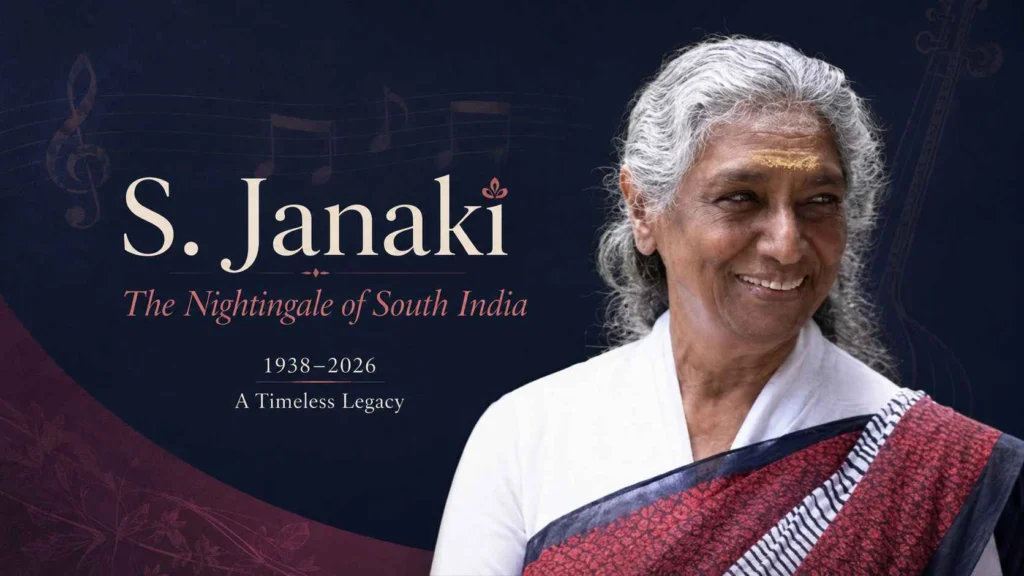
S Janaki biography: S. Janaki, also known as Janaki Amma and the Nightingale of South India, was one of Indian cinema’s most loved playback singers. Born on 23 April 1938 in Pallapatla, Andhra Pradesh, she sang across Telugu, Tamil, Kannada, Malayalam and many other Indian languages. S. Janaki passed away on 11 July 2026 in Mysuru at the age of 88, leaving behind a six-decade musical legacy.
S. Janaki Quick Facts
| Full name | Sistla Sreeramamurthy Janaki |
| Popular names | S. Janaki, Janaki Amma, Nightingale of South India |
| Date of birth | 23 April 1938 |
| Birthplace | Pallapatla, Guntur district, Andhra Pradesh |
| Age at death | 88 years |
| Husband | V. Ramprasad, also known as Ramu |
| Son | Murali Krishna |
| Profession | Playback singer |
| Active years | 1957 to 2016 |
| Known for | South Indian cinema songs, voice modulation and multilingual playback singing |
| Date of death | 11 July 2026 |
| Place of death | Mysuru, Karnataka |
Early Life and Family Background
S. Janaki was born in Pallapatla, a village in Andhra Pradesh’s Guntur district. Her father practised Ayurvedic medicine, and music entered her life early. Even before playback singing became her profession, family members and local listeners noticed her natural sense of melody, expression and timing.
For readers searching for S. Janaki born details, the key facts are simple: she was born on 23 April 1938 in Andhra Pradesh and later became closely associated with Mysuru, where she spent her final years.
Entry into Playback Singing
Her professional career began in the late 1950s, when South Indian cinema was growing rapidly and needed voices that could carry both classical depth and everyday emotion. Janaki’s voice did both. She soon became one of the most sought-after singers across Telugu, Tamil, Kannada and Malayalam cinema.
A Career Spanning Six Decades
What makes any S. Janaki singer biography remarkable is the range of her career. She was active from 1957 to 2016 and recorded songs in nearly twenty Indian languages. Her songs crossed regions, generations and film industries, which is why searches for S. Janaki songs, S. Janaki Tamil songs, S. Janaki Telugu songs and S. Janaki Kannada songs continue long after her peak recording years.
She was celebrated for expressive singing and voice modulation. Few playback singers could move so convincingly between a child’s innocence, a young heroine’s emotion and an older character’s warmth. That range gave her music a lasting place in Indian cinema.
Personal Life: Husband, Son and Family
S. Janaki’s husband was V. Ramprasad, often referred to as Ramu. He is remembered in biographical accounts as an early supporter of her talent. The couple had one son, Murali Krishna. Janaki generally kept her personal life private and allowed her music to remain the centre of public attention.
Awards and Recognition
S. Janaki received four National Film Awards and numerous state-level honours from South Indian film industries. Her recognition across Andhra Pradesh, Tamil Nadu, Karnataka and Kerala reflects how many regions considered her voice part of their own cultural memory.
Some of Her Most Loved Songs
Across languages, several S. Janaki songs remain fan favourites, including Senthoora Poove in Tamil, Thayiya Thandeya in Kannada and Oho Megam Vandhadho. Her catalogue runs into thousands of recordings, and many listeners still discover her through playlists, old film songs and tribute videos.
Death and National Tribute
S. Janaki passed away on 11 July 2026 in Mysuru at the age of 88. Her last rites were performed with state honours, and tributes came from fans, artists and public figures across India. For readers updating an S Janaki biography after 2026, her death in Mysuru is one of the most searched facts. For many listeners, her passing marked the end of an era in South Indian playback singing.
Why Her Story Deserves to Be Told
A complete S Janaki biography must do more than list dates and awards. Her story shows how one voice can become part of millions of private memories. At Maneesh Media, we believe cultural legacies like hers deserve to be preserved with care, whether through articles, biographies or beautifully crafted legacy books.
Readers who value stories of artists, leaders and families can also explore Maneesh Media’s Jewels of India series, our biography writing services and our work on family legacy books.
Frequently Asked Questions
Who was S. Janaki?
S. Janaki was a legendary Indian playback singer known as Janaki Amma and the Nightingale of South India.
When was S. Janaki born?
S. Janaki was born on 23 April 1938 in Pallapatla village, Guntur district, Andhra Pradesh.
What was S. Janaki’s age?
S. Janaki was 88 years old when she passed away in July 2026.
Who was S. Janaki’s husband?
S. Janaki’s husband was V. Ramprasad, also known as Ramu.
Did S. Janaki have children?
Yes. S. Janaki and V. Ramprasad had one son, Murali Krishna.
Where was S. Janaki from?
She was born in Andhra Pradesh and later lived in Mysuru, Karnataka.
When did S. Janaki die?
S. Janaki passed away on 11 July 2026 in Mysuru.
Why is S. Janaki famous?
She is famous for her six-decade playback singing career, songs in multiple Indian languages and extraordinary voice modulation. This S Janaki biography preserves the key facts readers search for most.