
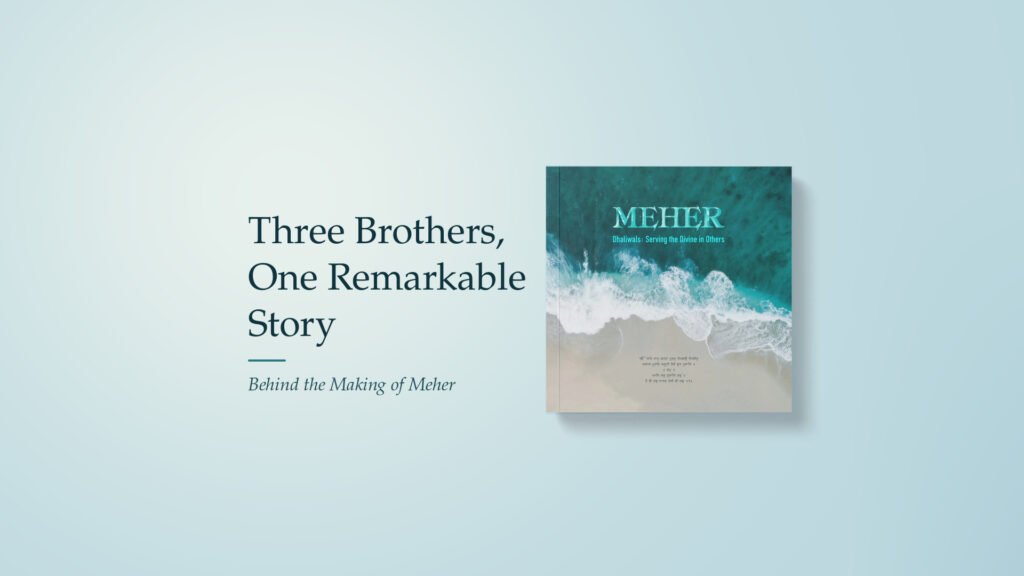
Every story begins with a premise and the central characters that lead the narrative. But what if the central characters were no longer of this world? What if, instead, their story needed to be told through not one but many characters? And then, how does one balance the focus of the story with the evolving information that one comes across?
These questions are among the few that we have to deal with when creating a book. But when it came to Meher –Dhaliwals: Serving the Divine in Others, there was no such confusion. The direction the book would take was simple. It would rest on the shoulders of those who created a family movement of Seva, a cycle of positive impact that has trickled down to the youngest of the clan.
The Two Protagonists
The family was clear. This book was about their inheritance from their parents. And this inheritance was not material. It was more valuable than that. It was the value of Seva and the upholding of their faith.
Throughout the book, even as we talked about the family – the immediate and the extended – the common thread were two very important names. Late Subedar Kartar Singh, affectionately called Bapuji, and his wife Jaswant Kaur, Bebeji, who had raised their family on principles deeply rooted in Sikh teachings.
Honesty, faith, generosity and service were integral to their lives. Their influence offered something that a chronological account of accomplishments could not: a way to understand the relationship between upbringing and individual choices.
The Three Mediums
Bapuji and Bebeji’s sons are individuals, but each is part of the other. A successful entrepreneur in Milwaukee. A reluctant politician in Punjab. A businessman who preferred working quietly behind the scenes. Darshan Dhaliwal’s journey offered the compelling ingredients of enterprise, international success and philanthropy. Surjit’s took us into the complexities of Punjab politics and grassroots development. Charanjeet’s contributions unfolded largely away from public attention, through his dedication to the family’s global business interests.
Each story stood independently. But the legacy of service brought them together.
Turning Philosophy into a Story
This presented another editorial consideration. How do you make faith and service engaging subjects for a reader who may know little about Sikh philosophy or the Dhaliwal family?
Certainly not by filling pages with abstract declarations. The more compelling approach was to allow personal anecdotes, family history and individual experiences to illuminate the principles at the heart of the book. Sikh teachings provided the philosophical context, while the brothers’ contrasting journeys offered the human dimension. The narrative could move naturally between Punjab and America, between enterprise and politics, between public accomplishments and private commitments. Rather than presenting service as a separate chapter in the family’s history, it became the idea connecting the different chapters.
A Book That Became More
The resulting publication, Meher –Dhaliwals: Serving the Divine in Others, brings together personal histories, family relationships, Sikh teachings and a multigenerational commitment to service. For Maneesh Media, its significance lies in the storytelling possibility of transforming individual accounts of achievement into a collective family portrait without losing the distinctiveness of each personality.
Yet, in the end it is about the two most important people – Bapuji and Bebeji, who started it all.