
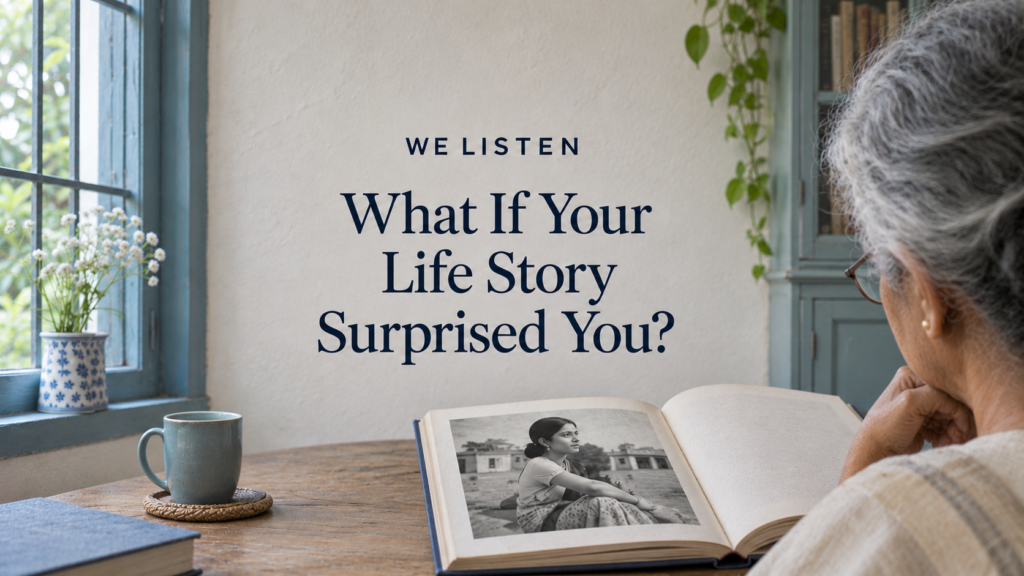
You have lived every day of your life. You remember the risks you took, the people you met and the decisions that changed everything. So surely nobody could tell you anything new about your own story?
Perhaps not. But they might show you something you had never noticed.
In the first instalment of WE LISTEN, we explored the stories families do not always tell. In the second, we considered why one life can produce several different—and sometimes conflicting—memories. The next question is less about recollection than recognition: what happens when a life is assembled into a narrative and the person who lived it sees the pattern for the first time?
Living a life is not the same as seeing its shape
Most of us experience life in episodes. A difficult move. A chance introduction. A professional setback. An unexpected act of kindness. Years later, these moments may seem unrelated. But a careful conversation can reveal how one decision prepared the ground for another.
Consider an entrepreneur who calls their success a matter of luck. A sequence of interviews might show a repeated willingness to begin again after disappointment. The storyteller has not invented courage. They have simply made a pattern visible.
The surprise of other people’s memories
Families are especially interesting because they remember us in roles we cannot fully observe. A parent remembers the child who questioned everything; a colleague remembers the leader who remained calm in a crisis; a spouse remembers the uncertainty behind a public success. Together, these perspectives can challenge the subject’s own account—sometimes gently, sometimes profoundly.
The aim is not to replace a person’s self-understanding with somebody else’s verdict. It is to make room for a richer view.
Meaning is discovered, not manufactured
There is an editorial temptation to turn every coincidence into destiny and every difficulty into a lesson. That makes for a neat story, but it can distort a complicated life. Good narrative work distinguishes what happened from what the subject or family now believes it meant. Connections should emerge from evidence and reflection, not be imposed for dramatic effect.
When the next generation reads it
The discovery does not stop with the subject. A child who has only known a parent as a confident business leader may learn about the uncertainty of their early years. A grandchild may discover that the family’s most familiar tradition began as a response to migration or hardship. The story can shift a relationship from assumption to understanding.
The mirror and the window
For the subject, a thoughtfully researched biography can be a mirror: a chance to recognise continuities across decades. For others, it can be a window into experiences they never witnessed. Neither effect is guaranteed, and not every subject will agree with every interpretation. But both possibilities make listening more than an exercise in transcription.
At Maneesh Media, WE LISTEN is an invitation to look beyond the chronology of achievements and ask what those experiences reveal. Sometimes the most unexpected reader of a life story is the person whose name appears on the cover. And sometimes the biggest revelation is not a forgotten fact. It is a new way of understanding a familiar life.